Jon Pope, owner & proprietor with his wife Michelle of Uncle Jon’s Coffee Houses, encountered an exceedingly strange sight as he dropped off Interstate I-195 onto Route 105 in Marion, Massachusetts. Traffic does, indeed, slow down quickly as one enters this sailing hamlet on Sippican Harbor. So, Jon is used to breaking hard in transitioning from Interstate to sleeping village. In this case, though, he got behind a four-legged rather than a four-wheeled entity. Jon jumped out of his car and rescued a male adult Eastern box turtle strolling down the off-ramp. As much surprised as Jon, this road warrior took an instant liking to his new two-legged friend.
Jon Pope Admires Rescued Male Eastern Box Turtle
His shell records a series of human encounters, none as pleasant as today’s rescue by Jon. Most of the forward marginals, the outer ring of small scutes rimming the carapace (top shell), have been broken off completely.  His rear marginals are nicked and chinked so much that they seem like serration.Â
Lots of Dings and Chinks along the Marginals of This Road Warrior
With his handsome red eyes, manly tail and plastron (bottom shell) concavity, this veteran road warrior exhibited all the traits of an exemplar male Eastern box turtle.
Male Eastern Box Turtle
Tonight we’re puzzling over an appropriate home to release our new reptilian friend. Clearly, the Interstate Highway System isn’t a safe habitat. He’s been lucky to have survived this long. So, we’ll be investigating potential Eastern box turtle habitat in the SouthCoast area.
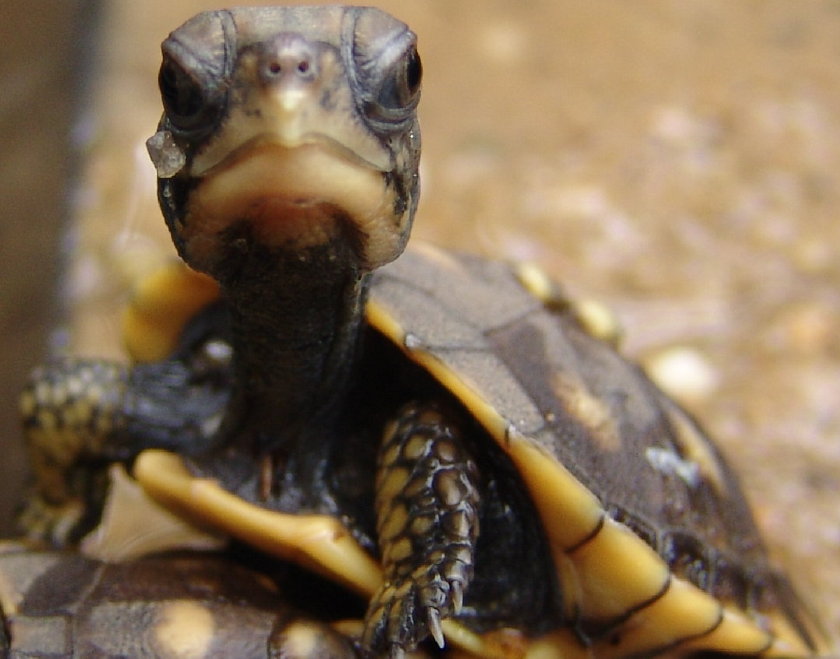
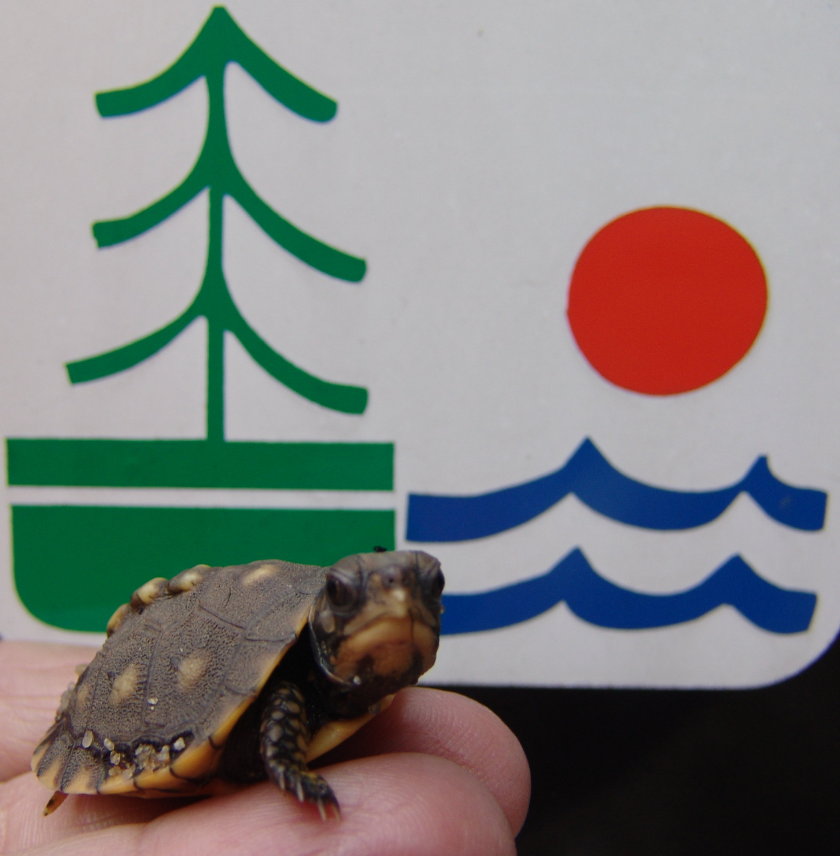
Eastern box turtle hatchlings combine the tenderness, vulnerability and “cuteness” of a tiny new born with the stoic appearance of ancient wisdom. Whether a reflection of the stored knowledge of hundreds of millions of years of fine-tuned DNA evolution or simply a “Fun House” mirror trick inside the brains of our less seasoned DNA, these little critters certainly take on the appearance of all-knowingness.
Â
Â
Eastern Box Turtle Hatchling
Â
“Speak to me, oh Sage of the Ages. Tell me the mysteries of life.”  Via trans-species telepathy we hear, “Sleep through the winter; sleep through the cold. Sleep through the storms and never be bold. Sleep when it’s chilly; sleep when it’s hot. Sleep when it’s cloudy and eat when it’s not.”
Eastern Box Turtle Hatchlings in Motion
These characters were uncovered in a surprise nest at the edge of the Fox Island Marsh Conservation Area and released back into the wild on Friday. See the full details of their discovery and release in the posting below.
The Fox Island Marsh Conservation Area lies in South Wellfleet and, along with its neighbor the Pilgrim Spring Woodlands Conservation Area, comprises 68 acres of woods and 100 acres of salt marsh. An exquisite parcel of these conservation lands is the Whale Bone Point Trail (see Google image below) described as the jewel in the crown for its unmatched overlook views of the Fox Island Marsh and Blackfish Creek. These lands are owned by the Town of Wellfleet and the Wellfleet Conservation Trust.
Whale Bone Point
This last week the Fox Island Conservation Area witnessed the arrival of babies from two Massachusetts protected species: diamondback terrapins (threatened) and Eastern box turtles (species of special concern). While the Whale Bone Point area had been assessed as box turtle habitat and the point has been documented as a terrapin nesting site, these are the very first babies of both species that have actually been discovered on the land as they were being born.  The conservationists, environmentalists and naturalists who worked to protect this precious habitat deserve two thumbs up, one for each of these listed species.
One of Four Eastern Box Turtle Hatchlings
Last week a resident abutting the Whale Bone Point area discovered four Eastern box turtle hatchlings in a nest in her mulched landscaping. That story was reported below under Eastern Box Turtle Hatchlings. These adorable babies were a bit disoriented, one might even say “grumpy,” at being so uncerimoniously disturbed from their post-natal snooze, and they were a little dehydrated, too. So, after a few days of turtle R&R, the foursome was released into the protected woodlands of Whale Bone Point near their nest site.
Release of Eastern Box Turtle Hatchlings
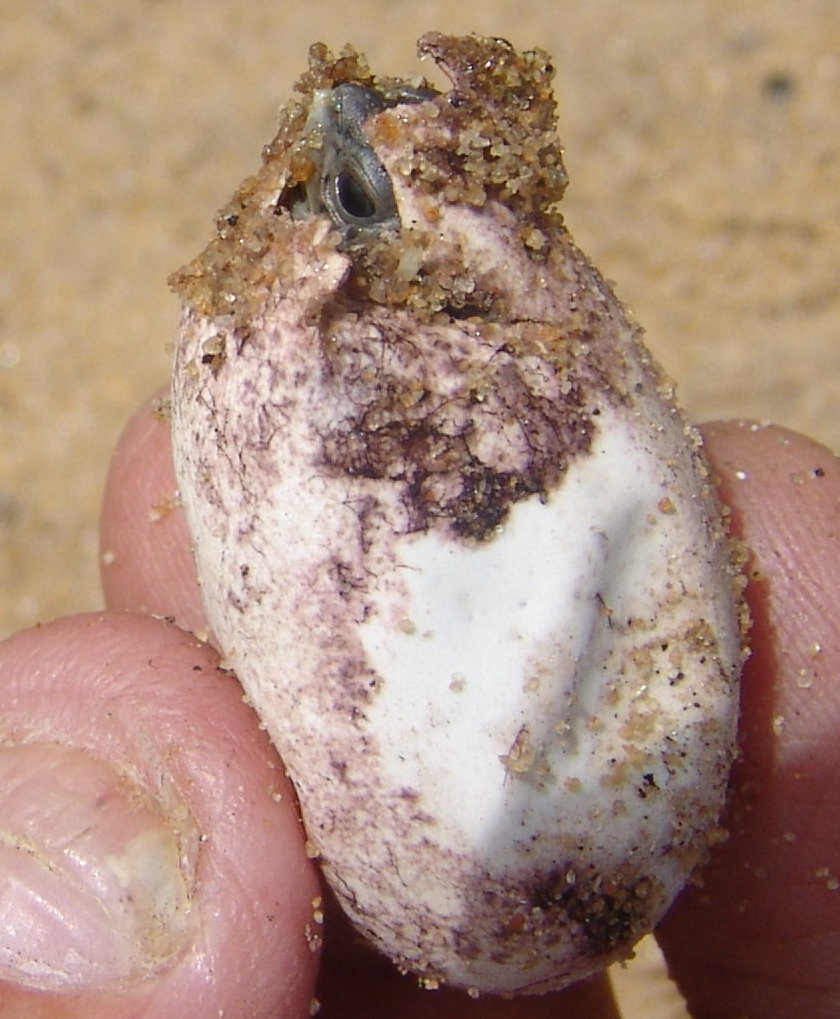
After releasing these box turtle hatchlings on Friday, we trekked down to the tip of Whale Bone Point where we had documented diamondback terrapin nesting since 2000 based on depredated nests and discarded egg shells. We discovered three emergence holes within about 12 inches of each other that contained the remnants of escaped hatchlings, undeveloped eggs and some eggs that had been destroyed by root and insect predation. In the middle nest, tucked under the lip and cradled in roots that had drained moisture from the nest and had contorted the embryos inside their egg shells within their nose-like grip, three pipped and cracked eggs remained.  One had not survived the attack, but two others were alive, albeit distorted, severely dehydrated and frozen in a trance-like stupor. The clip below documents our removal of one of these hatchlings from its egg cocoon; the babies were so weak that they couldn’t free themselves from the dried egg shell and dig themselves out of the nest.
Rescue of Terrapin Hatchling Trapped by Roots and Dehydration
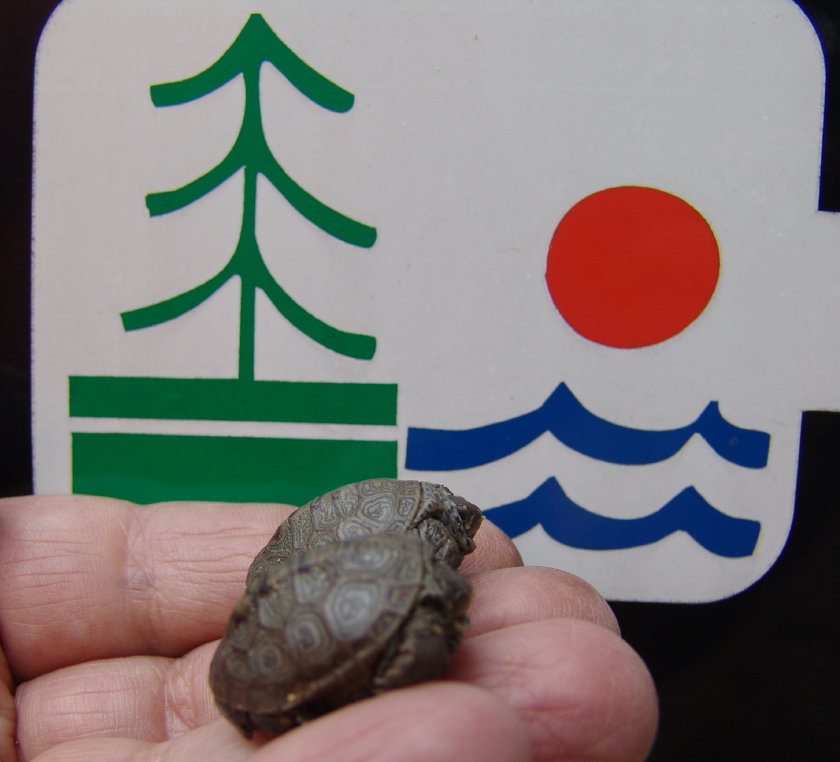
You can see from the clip above how undersized these hatchlings are. The image below gives you a good sense of their actual size.
Undersized Terrapin Hatchlings
The good news: Terrapins (and most turtles, actually) are Timex critters. “They take a licking and keep on ticking.” Turtles are extremely resilient. Given a little TLC, even the most hapless turtle can be given a head-start toward survival. These two babies just need a few days of care before they, too, will join their siblings in the nursery salt marsh abutting the Fox Island Marsh Conservation Area. And in about eight years … Mark your calendar for June 15th, 2016 … they may be returning to Whale Bone Point to deposit their own nest of hatchlings. And so the cycle goes on. Save one turtle and your action ripples through the ages. Precisely like the “Time Machine” that Nature truly is.
Two Terrapin Hatchlings Released at Whale Bone Point
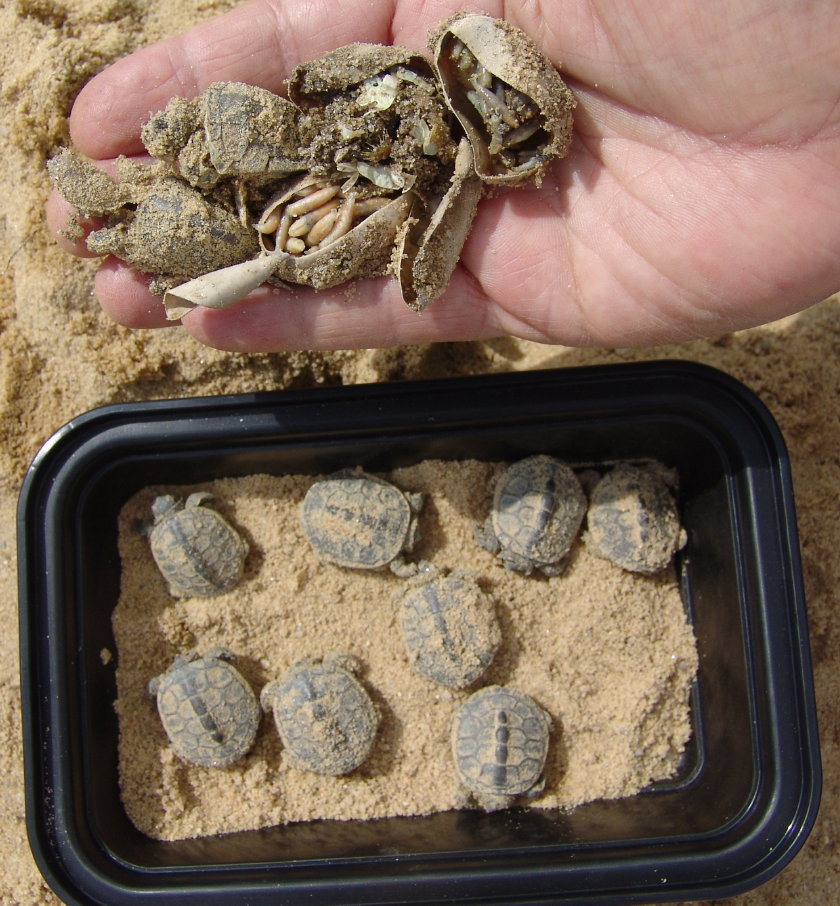
As we described earlier in the post, “Rescuing Live Hatchlings from Maggot Infested Nests,” fly maggots devastate threatened diamondback terrapin nests on the Outer Cape. They devour tiny, vulnerable hatchlings as they break their eggshells in the secret darkness of their hidden underground nests. When we encounter a nest infested with maggots, and after we suppress our disgust and repulsion, we aggressively excavate the egg chamber in order to save as many hatchlings as we can.
Terrapin Egg Completely Consumed by Fly Maggots
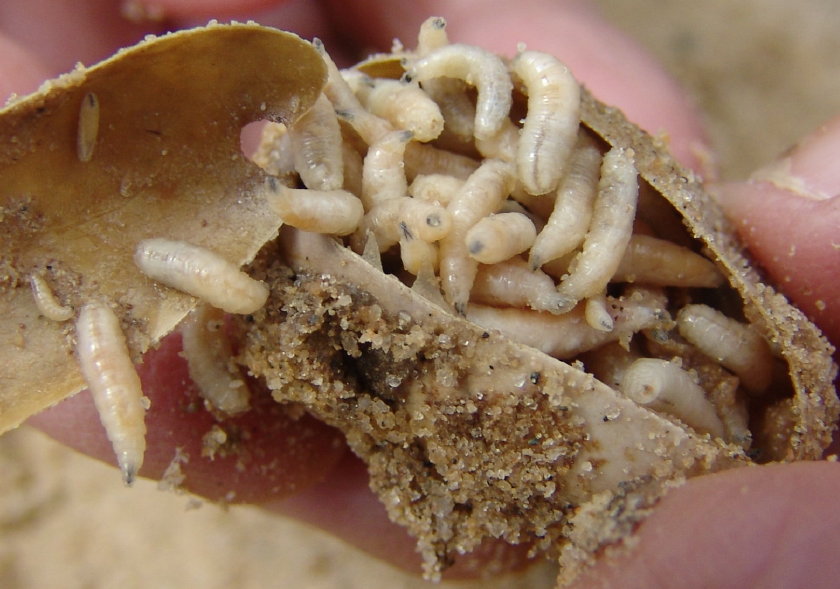
This Thursday we checked on a nest laid late last June in a new turtle garden off Broadmarsh River in Wareham, 60 miles from nests on the Outer Cape and on the other side of the Cape Cod Canal. Still, once we penetrated the egg chamber the sand resembled an Indiana Jones movie scene with maggots playing the role of snakes. “Maggots,” exclaims the Turtle Guy. “Why does it have to be maggots?”
Maggots in Motion
We ignore the stench and dig quickly through the slithering sand to rescue eight live hatchlings among the devoured remains of eggs and embryos of seven might-have-been siblings.Â
Eight Saved, Seven Depredated by Maggots
The rescued hatchlings appeared lethargic as though traumatized by the experience. But after an overnight stay in clean, moist soil, and a leisurely bath in warm fresh water, they were eager for release into the wild. That is, turtle eager which isn’t quite the same thing as mammal eager.
Hatchling Strolls through Wareham Turtle Garden
The background of the previous video clip shows the exquisite nesting habitat that was created by private homeowners abutting the nursery salt marsh of Wareham’s Broadmarsh River off Buzzards Bay. At their own initiative and their own expense, the homeowners petitioned the Town of Wareham Conservation Commission for permission to create a perfect nesting habitat along a beach front that had become sand starved over the years and had lost all upland nesting potential. These generous homeowners ordered 20 tons of perfectly matched beach sand to make a large nesting site at least 10 inches deep for terrapins to place their clutches. Within a couple of weeks of completing this turtle garden, the first female terrapin had scratched and dug her nest. In total, six nests were deposited in the new sandy turtle garden … all of which were protected by predator excluders. As these new babies mature, they too will return to this turtle garden, ensuring a whole new generation of diamondback terrapins in Broadmarsh River; all thanks to an exceptional family who are dedicated to restoring the Wareham coastal ecosystem for future generations.
The Turtle Journal team gets close to the action to bring you inside the critical natural moment with vivid imagery and compelling video clips.Â
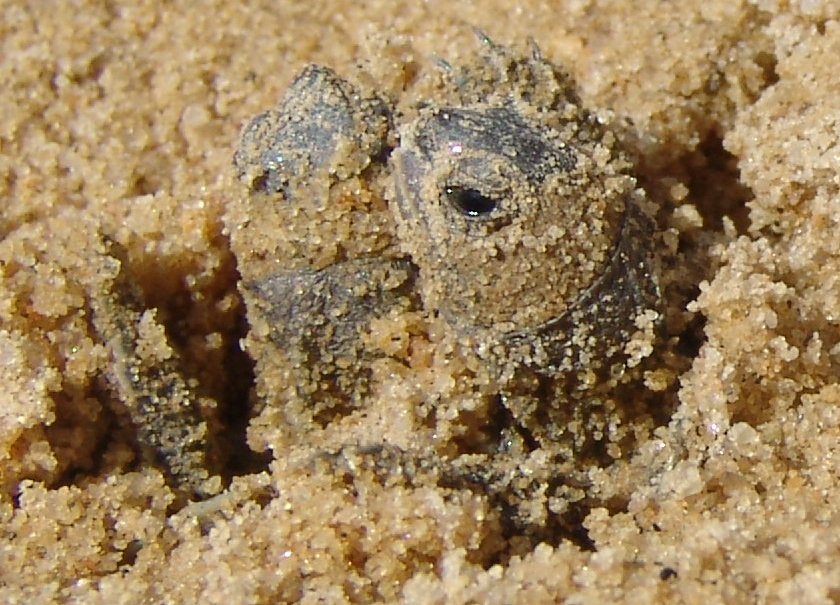
Sue Wieber Nourse Snaps Close-Up of Emerging Hatchling
The Sony DSC-F828 serves as our workhorse research camera with a high quality Carl Zeiss lens and a manual zoom ranging from macro to ~ 135 mm telephoto. We have two F828s, one that shows all the signs of several years of salt water and sand dunes, and a second one with only a single research season under its belt. The F828 produces excellent digital stills, but also provides the capability to switch quickly to medium quality video to document important research events.
Terrapin Hatchling Pips through Its Eggshell
If the F828 is our workhorse, the Pentax Optio W30 with its built-in underwater capability is our pocket miracle maker. The underwater housing serves double duty. Surprisingly, not every field day is sunshine and light. More days than we wish to remember are filled instead with rain, wind and storms. For instance, the leatherback necropsy last Sunday was done outdoors (obviously) in a driving rain storm. The only camera present that could document the post mortem was the Optio W30. Â
Don Lewis Zooms In on Emerging Duo for a Close-Up
Having lost three previous digital cameras to salt water, the Optio W30 is perfect to document all action near, above and below the water line. Its compact shape and light mass allow the camera to slip comfortably into field pockets and even bathing suit pockets. This camera takes excellent macro video clips in QuickTime format and good quality stills when the F828 isn’t around.
Close-Up of the Emerging Duo
The one drawback with the Optio W30 is the LCD screen. The camera fell from my swimming suit pocket about 12 inches onto sandy soil during our June field school. The fall appears to have jarred the LCD screen which has dropped to about 10% functionality. In essence, the camera now is a point and guess. Still, the Optio W30 brings home some sweet imagery … when pointed in the right direction and in the right mode of operation.
The most important instrument for capturing the right shot at the right moment has nothing to do with digital anything. If you can’t get yourself to the perfect spot at the perfect time, your top quality camera will capture a whole lot of sea gulls, sand dunes and fiddler crabs.