Archive for the ‘Turtles’ Category

Skill + Luck + Patience Yield Best Dune Emergence Sequence

Monday, September 22nd, 2008

Skill brings you to the precise location where an extraordinary event MAY occur.  But luck ensures that you reach that spot at the once-in-a-lifetime moment when an extraordinary event DOES occur.  Finally, patience permits you to dwell at the right spot at the right time for that exact instant when everything comes together and a miracle happens.  Watch how these factors brought us to the perfect dune emergence sequence on Saturday.
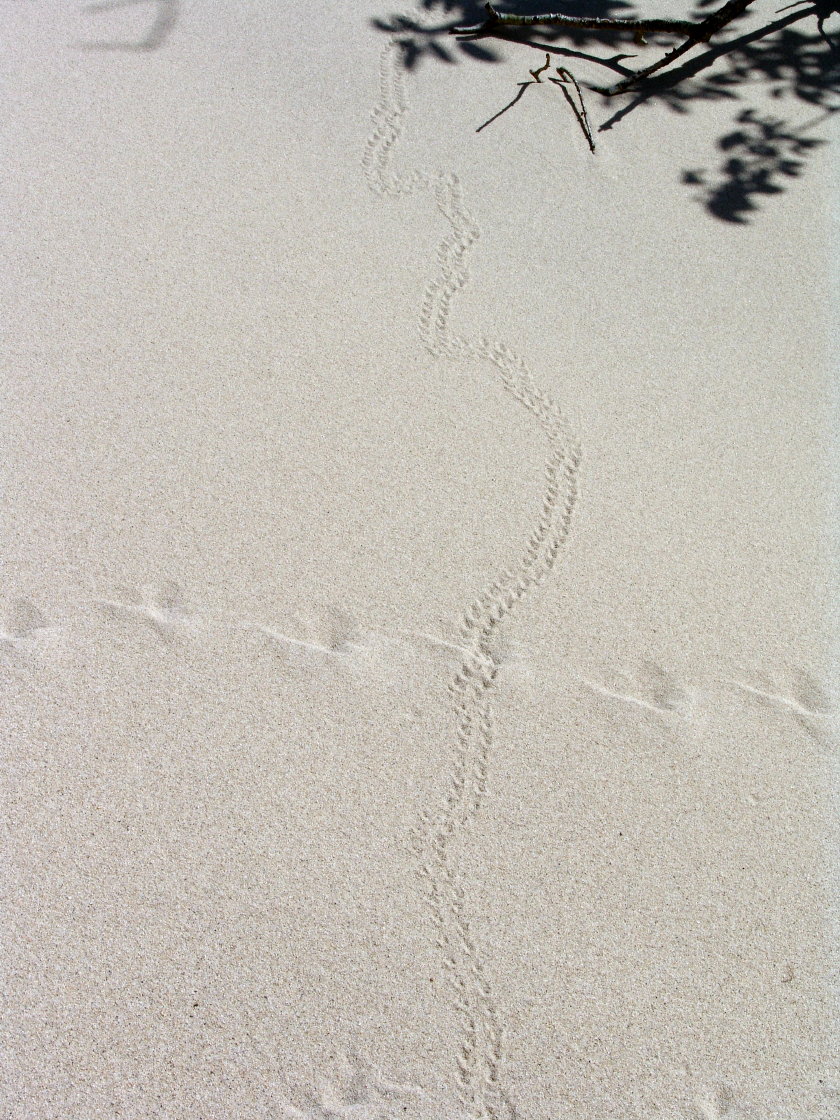
Hatchling Slaloms Down High Dune

Experience keyed us to a certain set of dunes that lay within a dense diamondback terrapin nesting site.  Skill enabled us to recognize a series of fresh hatchling tracks that crisscrossed the dune face like trolley lines (see above).  But then luck kicked in.  It showed us a stream of tracks that appeared to converge on a single concavitiy in the dune slope (see below). 

Tracks Converge at Possible Emerging Terrapin Nest

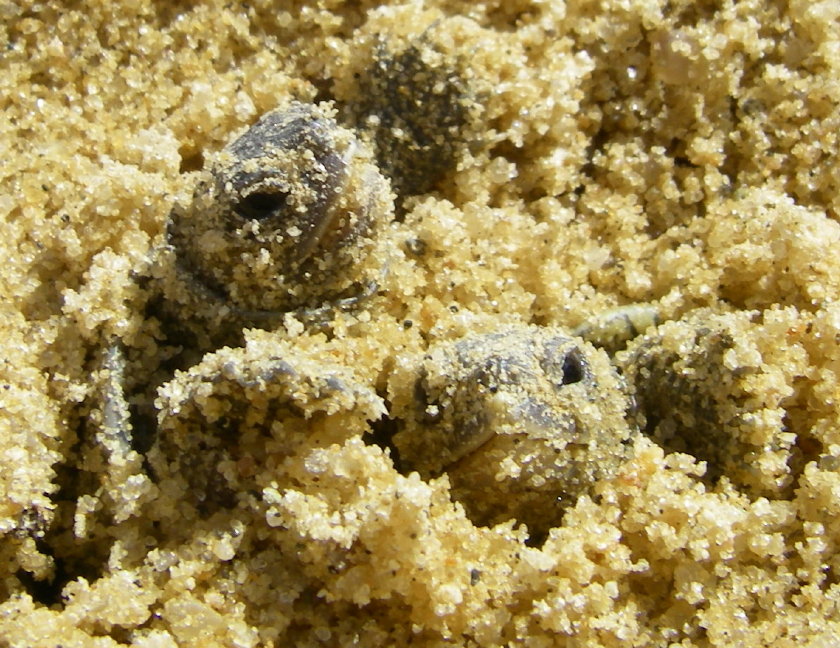
Patience gave us to time to wait and to watch the concavity without barging into the scene and disturbing the ongoing miracle of birth.  Seconds ticked by, then minutes, and finally a head poked through the shifting sand … and another one.  Hatchlings popped like slow-motion popcorn under the heat of the midday sun.

Hatchlings Emerge and Scramble to Safety

Spying so many tracks when we arrived, we had hoped that perhaps one hatchling might be left to emerge.  As luck would have it, ten babies remained in the nest and they popped out in ones and twos over the next hour.  As a whole, the event proved our very best documented dune emergence sequence as a beautiful miracle unfolded before our eager camera lens.

Click Here to View Video in High Quality

Best Terrapin Hatchling Emergence Sequence
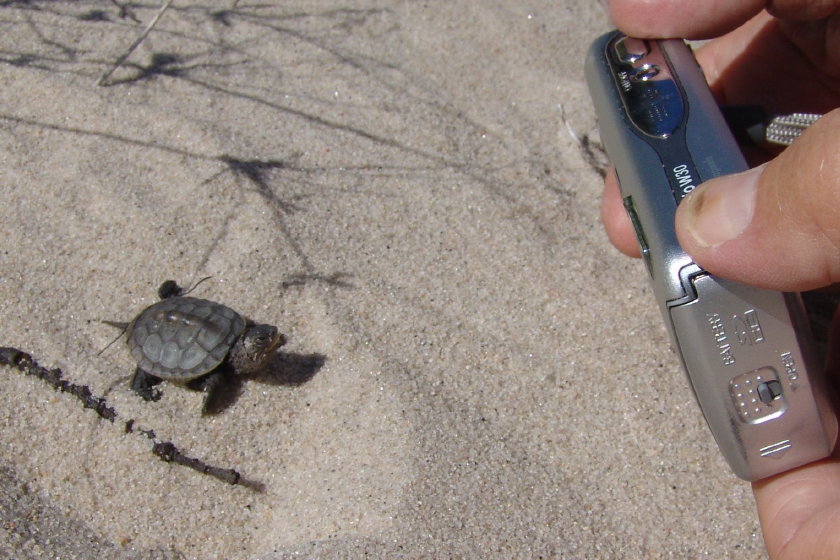
Behind the Scenes: Best Dune Emergence Sequence

Monday, September 22nd, 2008

Stepping behind the scenes, we see how skill and luck and patience were aided by technology to produce the best documented dune emergence sequence.  The Pentax Optio W30 enabled us to get within inches of the action as tiny hatchling poked through the sand and then scrambled down slope like Olympian skiers.

Pentax Option W30 Documents Hatchling Emergence

Their very first view of the world after more than two months buried under the sand is hampered by the blindingly bright high noon sun.  They pause to get bearings which appears for all the world as though they are mugging for the camera.

Hatchling Mugs for the Camera

The clip below documents how we capture these events for the Turtle Journal.

Getting Close to the Action

And finally these ten beautiful little miracles are released into the relative safety of the nursery marsh.

Ten Hatchlings Head into Marsh under the Camera’s Gaze

As Arrival of Fall Speeds Up, Turtles Slow Down in the Great White North

Thursday, September 18th, 2008

Raw, blustery September has gripped terrapin nesting sites on the Outer Cape.  As temperatures plunge, hatchlings hunker down in their underground hide-aways, snoozing in the warm darkness, hoping and waiting for a sunny respite to heat up the sand and their bodies for the sprint from nest to safety in the abutting nursery habitat.

Temperatures Begin to Plunge Below 55F Activity Threshold

Yet, while they wait with quiet patience, predators act.  Mammals and insects sniff the odor of organic material issuing from the pipped eggshells.  These predators take advantage of the hatchlings’ stupor to snatch an easy meal.

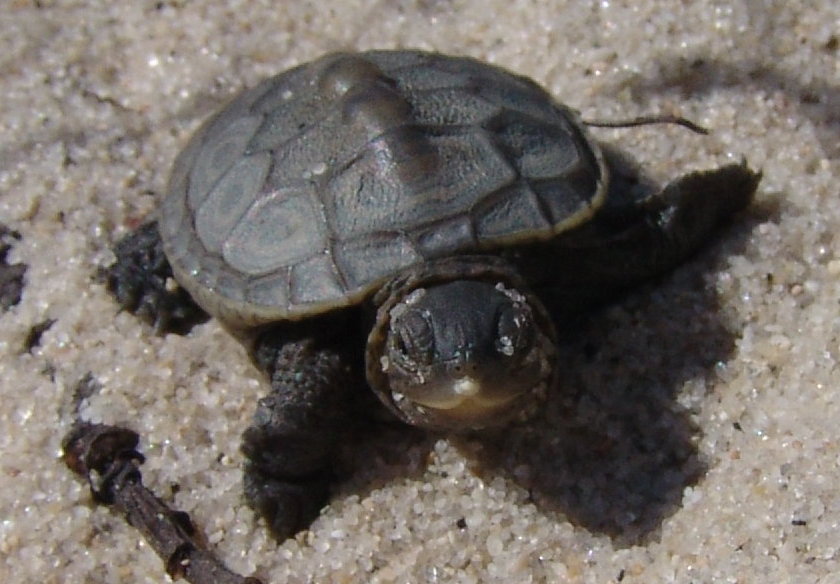
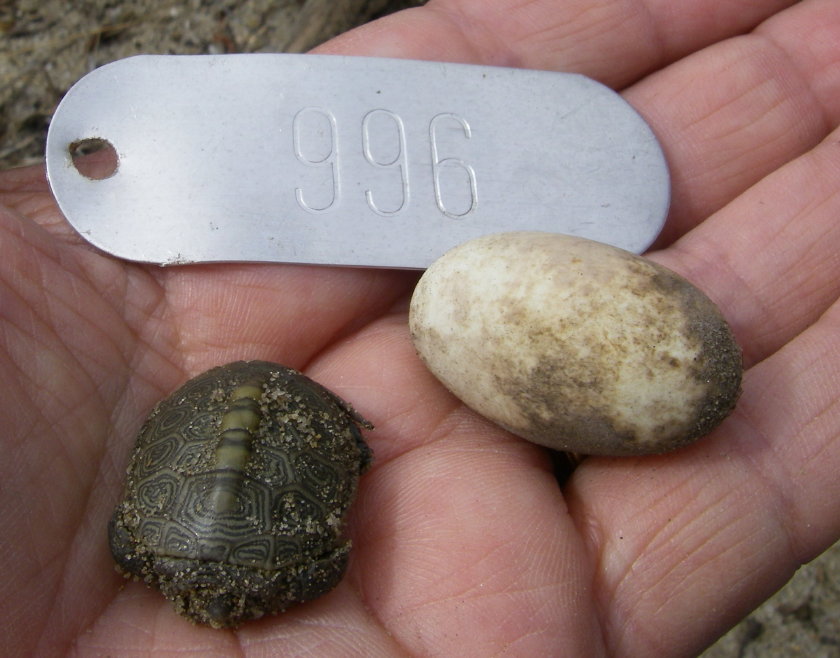
Lethargic Hatchling and Potentially Viable Egg

Nest 996 fell victim to secretive plant and insect predators.  As we excavated the nest in the morning chill, we encountered egg after egg that had been attacked by roots, stilting embryo development and piercing the shell.  Once the egg is cracked, insects stream in and consume the organic material.  Near the bottom of the nest, we found a seemingly lifeless hatchling wrapped in an eggshell that we would have instantly discarded as non-viable.  Peeling the shell away, we found a healthy, if motionless hatchling.  And at the bottom of the nest, we removed one potentially viable egg that has been carefully transplanted to the “second chance” bucket where eggs go to finish incubation and hopefully achieve their full potential.

Excavating Six Sluggish Hatchlings

A few feet away we discovered a concavity in the sand that indicated that a pipped nest might lie beneath.  About four inches under the surface we found a half dozen hatchlings, some pipped but still inside eggshells, but others just snoozing the chill away.  Check out these sluggish babies once they are excavated as they lie about like cordwood, waiting for sunshine to warm their bodies before dashing to freedom.

September weather in the Great White North can be cruel for tiny hatchlings.  But a saving hand can make a world of difference for this threatened species by dramatically increasing the number of live hatchlings that enter the ecosystem each year.

Abiogenesis: Spontaneous Generation of Life

Wednesday, September 17th, 2008

Back in the salad days of youth we laughed in giddy hubris to learn that supposedly brilliant Aristotle had been so foolish to espouse the theory of abiogenesis, the spontaneous generation of life.  How much more intellgent we were to know that life could not spontaneously generate from inanimate matter.  How could those famous Greek philosophers be so silly?  It fully demonstrated to our proud satisfaction the false premise that human brains had evolve so completely in a mere two thousand years that we high schoolers could out-think the great philosphers of the Golden Age.

Imagine Aristotle Strolling by Just as This Hatchling Emerges from the Sand

Surprising how much our intelligence regresses in maturity.  The brilliance of youth gets tempered by wisdom and experience.  And while we still know that abiogenesis is a failed theory, it’s a heckuva lot easier to understand how the great minds of the ancient world could be fooled by physical observation.  If one never happened to spot the female turtle dig and bury her eggs into the ground, and one strolled by just as a perfectly formed hatchling turtle emerged from the sand, one could be forgiven for thinking that you had just witnessed the spontaneous generation of life:  a turtle springs forth from the sand.

If Aristotle Saw Two Turtles Emerging Would That Change His Mind?

Events such as these are exceedingly rare to witness.  But over the last decade, I’ve been privileged to observe “spontaneous” emergence from the sand a handful of times.  Each occurence reminds me of philosophy class and how nearly two and a half millennia ago our Greek intellectual ancestors had conceived a perfectly logical explanation for this seemingly magical and mysterious event.  Instead, today we demonstrate our intellectual superiority by telling the tale of the turtle and the egg.  You know, which one came first, the turtle or the egg?

Headcount!

Tuesday, September 16th, 2008

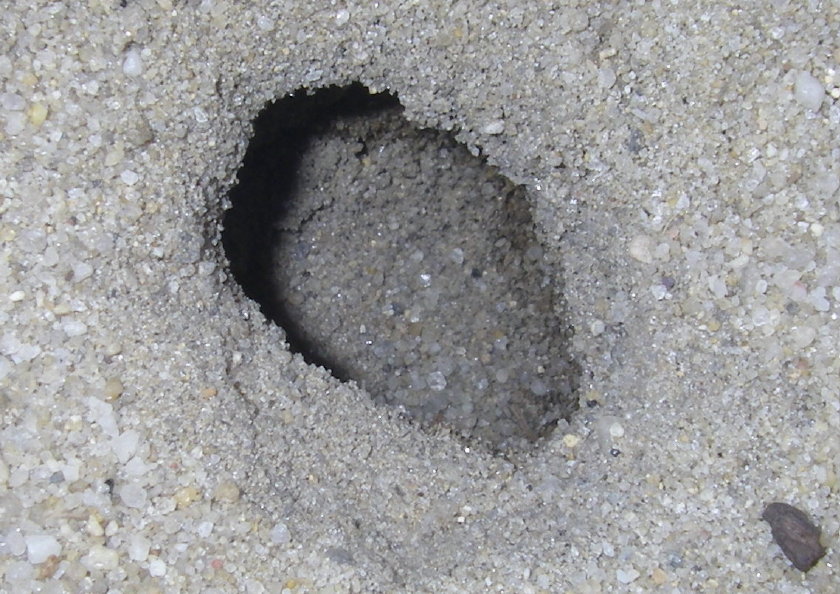
Emergence Hole About 1.5 Inches Long x 0.5 Inch Wide

Today brought a cool overcast to the Outer Cape as September’s autumn preview now grips the Land of Ooze.  Hatching had slowed to a crawl as temperatures fell and clouds rose.  So, we expected little from our afternoon rounds that began at Griffin Island where the truly northernmost terrapins in the world reside, stopped by Indian Neck on the north shore of Blackfish Creek and crossed over to Lieutenant Island on the south shore.

Another Emerge Hole, Same Size as Previous

Surprise!  Emergence holes and emerging nests greeted us at every stop.  Two on Griffin Island:  one on the shoulder of an asphalt road and only about five inches deep because mother hit pavement, and the other along a boardwalk leading to the Herring River salt marsh.  Eight live hatchlings emerged from the first nest and four succumbed to maggot depredation.  Sixteen hatchlings escaped from the second nest into the salt marsh.

Camouflaged Emergence Hole

When I spotted the emergence hole for the second nest, I burst into laughter.  A clump of pine needles had obviously been blown atop the hole by a recent storm.  But it looked so carefuly placed so as to camouflage the nest and give emerging hatchlings cover from predators as they bolted into the safety of the Herring River marsh.

I also hadn’t noticed until this posting the near identical similarity in shape of the first two emergence holes pictured above.  Sure, these critters are nearly identically sized at the hatchling stage, ~ 2.7 cm carapace length and ~ 6 grams mass; but after observing the chaos of an emerging nest (see the video clip below), I’m amazed by the twin shapes. 

Count the Heads as They Emerge

We arrived at the Indian Neck nest just as the clutch began to broil.  Heads popped up for a peek of their brave new world and quickly receded again under the dirt … to be replaced by a new set of darting eyes.  Try keeping a headcount as babies appear.  These thirteen lively characters could easily convert this performance art into a comedy circus routine that I would gladly book for a World Tour.

Hatchling Emerges from Nest; Note Pointy Egg Tooth

The shifting dune sand on the Hook of Lieutenant Island makes finding an emergence hole impossible, except immediately after a drenching rain storm.  No such meteorological assist was in the cards.  One hundred percent overcast, but no rain.  Still, luck played in our favor.  We first spotted a collection of hatchling tracks slaloming across the dune slopes.  Tracing these signs back to a convergence point, we ran smack dab into a terrapin hatchling just emerging from the nest.  Behind this baby, three more waited their turn to make a break for freedom.

Nest Completely Depredated by Fly Maggots

While we rejoiced in more than 75 live emerged hatchlings documented during our rounds this afternoon, we did have one sad encounter.  Nest 210, which we had been monitoring since June on the Boathouse dune, had been completely depredated by fly maggots that had consumed all the hatchlings, leaving  behind only a thin layer of each carapace.