Archive for the ‘Wild Animals’ Category

Leapfrogging Sea Turtle Patrol Yields Surprise

Monday, November 17th, 2008

Saving the World One Toad at a Time

Winds howled across the bay Saturday into Sunday, blowing first at 30 knots from the south southwest and then 25 knots from the west southwest.  Air and water temperatures still lingered too close to 50 for any real expectation of cold-stunned sea turtle strandings, but with a high tide at 1:30 pm on Sunday, the temptation was too great to resist for a beach patrol.  Something like a road trip … only without the road, and without the trip, too.

Cape Cod Bay: Place a Pin in the Center

To plan where to focus your search, you need to understand that cold-stunned sea turtles are helplessly in stupor, and are tossed about like flotsam and jetsam.  Look at the map above and place a compass or a pin in the center.  Plot the reciprocal direction of the wind and use where it hits the coastline as the mid-point for your search.  So, with winds out of the west southwest, the Turtle Journal team leapfrogged from Bound Brook in north Wellfleet through Ryder Beach in south Truro to Fisher Beach and the Pamet River. 

Leapfrogged?  Yes, leapfrogged.  When patrolling high tide beaches for sea turtles, you’re out in the worst (or best, depending on your perspective) wind conditions and often the worst weather conditions with freezing rain or icy snow pelting the ground and everything and everybody between sky and ground.  The best approach is always to walk with your back to the wind.  Easier said than done?  Not if you leapfrog.  With a single vehicle and two sets of keys, someone is dropped at the first beach and walks with back to the wind.  The second person drives to the next beach, usually about two miles away, leaves the vehicle and begins walking with back to wind to the next beach.  The first person picks up the car and leapfrogs, and the process continues until the end of the patrol.

Click Here to View Video in High Quality

Sea Turtle Patrol at High Tide on Ryder Beach, Truro

It was sensational … in the literal meaning of the word.  Screeching winds, crashing waves, rumbling breakers overwhelmed hearing.  Blistering sand and ricocheting spray assaulted unprotected skin.  Sunny warmth battled with chilly gusts.  Brilliant blues, blinding whites competed with darkening clouds and then premature sunset.  It was an afternoon that defied description and won.

Click Here to View Video in High Quality

Cold-Stunned American Toad on Bound Brook Dunes

While the beauty of the afternoon exceeded expectation, the lack of sea turtles met expectations.  Still, leapfrogging must have given us an edge to find another cold-stunned critter in the dunes between the parking lot at Bound Brook and the beach.  Movement caught Sue’s eye as she climbed the dune and she spotted an animal in a depression that had been filled with water by the weekend rains, but was now only damp.  She approached and found a toad that was clearly having difficulties in the cold blast.

Click Here to View Video in High Quality

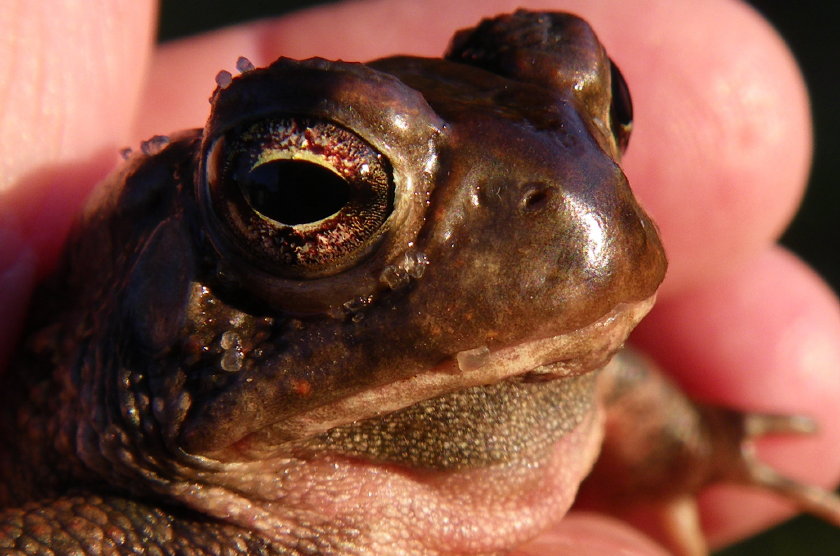
Examining Cold-Stunnded American Toad (Bufo americanus)

Although rare, we would have expected to find perhaps a spadefoot toad or a Fowler’s toad in this dune habitat.  Yet, the specimen appeared for all the world to be an American toad (Bufo americanus).  Oh, well.  That will teach us to leapfrog!
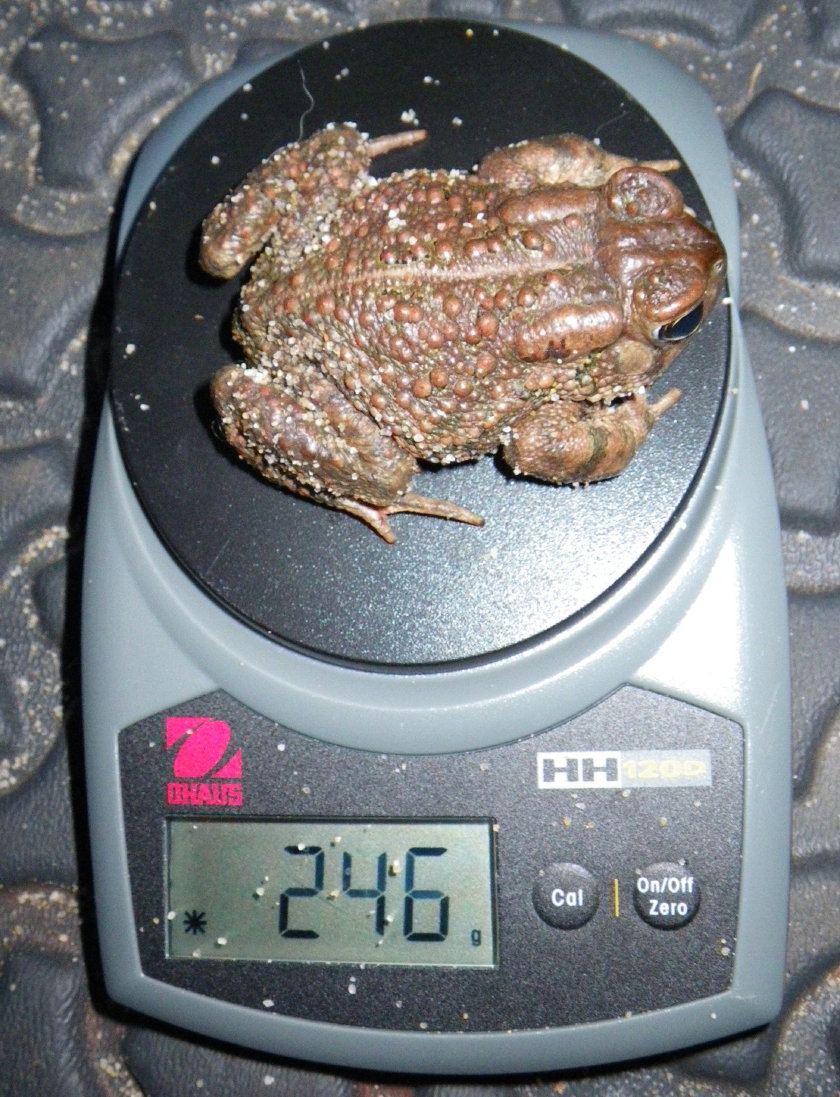
American Toad (Bufo americanus) Weighs 246 Grams

We examined the animal in detail on the beach, and perhaps because we had no turtles to bedevil, we recorded weight and measurements.
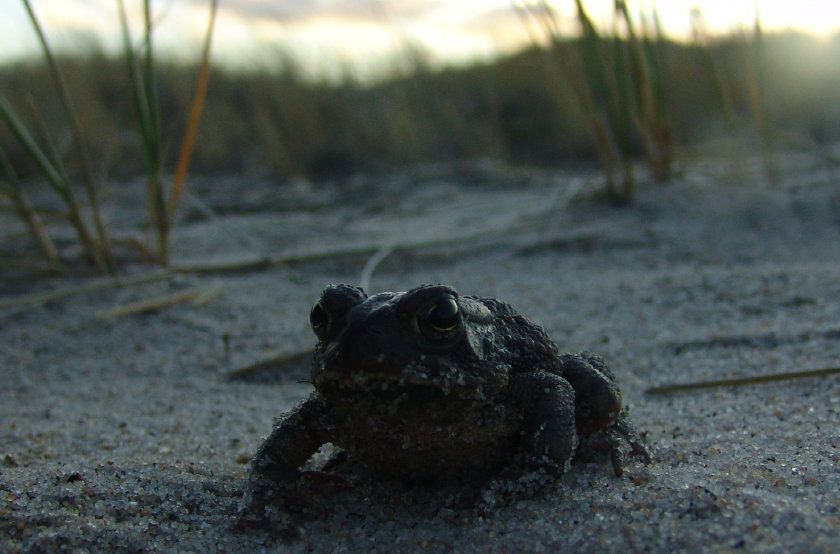
American Toad on Freezing Cape Cod Beach at Sunset

The sun had fallen low on the horizon when we encountered this toad and temperatures were dropping faster than the Dow Jones Index on Wall Street.  Its behavior was unusual and it wasn’t responding well to the deepening cold.  So, we filled a bucket with sand and brought it to the Turtle Journal lab for a couple of days of rest, recuperation and warmth.  This critter may not be a turtle, but if you don’t have one around, perhaps you can save the world with a toad in a pinch.
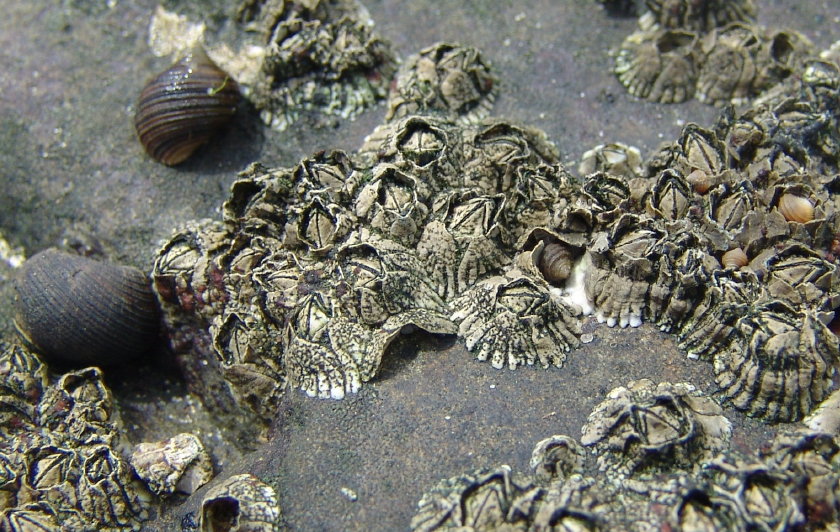
European Invaders: Periwinkles

Saturday, October 18th, 2008

As we explore the intertidal zone, that area between low and high tide where land and sea are locked in eternal battle, where life must confront pounding surf one moment alternating with barren exposure to rasping winds the next, where creatures are attacked by water predators half the time and land predators the rest of the day, where everything is drowned in brine at high tide and then soaked in rain at low, a harsh clime of extreme contrasts that change as quickly as New England’s weather; as we search this region we find one of its more common residents, the languid and familiar periwinkle (Littorina littorea).  Some scientist sure wanted us to remember where this critter came from with both genus and species derived from the Latin littoralis (or litoralis) meaning “of the shore.”

Periwinkles and Barnacles

My earliest memories of Cape Cod sealife are of periwinkles dotting the rocky sidewalls of the canal where my mom and dad brought me each Sunday to fish.  Back then fishing was less commercial, yet not purely recreational, either.  Yes, it was a break from the intense six-day, back-straining work week, but no excurision was successful unless you brought home food that would supplement household resources, especially for meatless Fridays.  And while fish were plentiful and Sunday after Sunday yielded flounder or cod or tautog or bass for the family table, there were days when the fish just “weren’t biting” and we had to look elsewhere on the food chain to meet our needs.

Blue Mussels

Next down our list were blue mussels that grew in large colonies on the old mud flats near the railroad bridge.  Back in those days few people ate mussels.  So, it’s amusing five decades later that you can’t read a seafood menu without mussels marinara or mussels something.  But if the tide was too high and our access to the flats was cut off, there was always one last food source to exploit: periwinkles.  They may have been small, but they were plentiful, very plentiful.  And no one, no one ate or even thought of eating periwinkles.  Yet, mom sauteed them in butter and garlic, then tossed them into her fresh spaghetti sauce for flavoring instead of pork or beef on meatless Fridays.  Many years later when I visited my parents and brought them out to dinner at a fancy Boston restaurant, I suggested to mom that she try the escargot, sauteed in garlic and butter, as an appetizer.  She looked at me as though she had raised a barbarian.  “Snails!  You want me to eat snails!”  I smiled, apologized and suggested the mussels marinara.

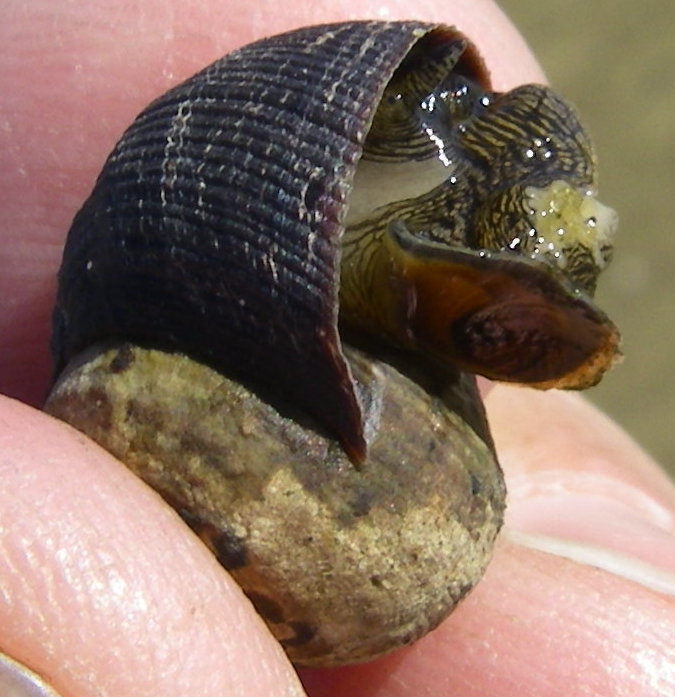
Periwinkle (Littorina littorea)

While an extremely common critter along our rocky shores, jetties, dock pilings and tidal pools, periwinkles are not native to North America.  They are an invasive species introduced into the Northeast perhaps sometime in the 19th century.  First documented in Nova Scotia in the mid-1800s, periwinkles can now be found in plentiful numbers up and down the Eastern Seaboard.  Whether they were brought to our shores deliberately as a favorite food of European settlers or they hitchhiked across from Europe in ballast water or clinging to creases in ship plankings, the method of their arrival is clouded in history.  They are consumed extensively in Europe today and are increasingly being harvested from New England shorelines.

The main body of this small, shell-covered snail is comprised of a large foot, head and mantle, covered with a protective operculum (see image above).  The operculum, a tough, horny “door” snaps the snail’s soft, vulnerable body into the shell during dry spells such as low tides. 


Periwinkle Anatomy


Two antennae (chemosensory organs) peek out from a fleshy foot.  In the image above you can see one eye near the stem of the higher antenna and the snout between the two antennae.  The sole of the foot is the curved white surface behind (below) the operculum.  The muscular, mucus laden foot enables the periwinkle to move along rocky boulders and transverse rocky and sandy shores in search of food.  Periwinkles are herbivores.  They graze copious amounts of algae such as the the macro algae sea lettuce (Ulva lactuca) and much smaller diatoms (phytoplankton).


Periwinkle in Action


Factoid:  Periwinkles have a serrated, rasping, knife-like tongue called the radula.  The radula scrapes algae from rocks.  (In other snail species, the radula bores through hard shells like quahogs, oysters, et cetera.)  For periwinkles, the algae is mixed with mucus and then passed into the digestive track.

Predators include crabs, seastars, birds and now a voracious worldwide human population.

In the Wake of a Moonsnail

Wednesday, July 30th, 2008

If you have the time and the tide
When a moonsnail passes,
Follow closely its trail …

In life I know
Epic tales are told
Of a great white whale

And now I know
Epic tales unfold
In a moonsnail’s trail.

Moon Snail Trail

All for Naught? — 6 May 2001

Sunday, May 6th, 2001

Don’t let anybody fool you.  In a good research program, you still have to score a string of goose eggs (documenting negative occurrences) unless you’d rather depend on Karnak-like intuition to tell you what’s inside the sealed envelope.  So, conditions of a pre-dawn low tide in 45 degree temperature and northeast winds at 15 to 20 knots suggest that terrapins would prefer to burrow under a warm layer of ooze rather than be flushed out of their safe and comfortable marsh habitat.  But there’s only one way to confirm this suggestion — and not many volunteers to do so.

05-06-1

Full Moon Illuminates Pre-Dawn Low Tide

I arrived on Lieutenant Island a little before 0430.  A nearly full moon hovered over Great Island in the west, while a dull rosy glow, about the strength of a 2.5 watt nightlight, simmered in the east.  The creek was cloaked in textured darkness, layers of ripples hinting at what lay beneath.  In chest-high waders I plunged across the channel.  Mating horseshoe crabs dotted the rapids like rocks on a Maine shore.  But terrapins?  None — no heads snorkeling for air, no shells rippling the current, no turtles paddling through the rip.

05-06-2

Sunrise over Old Wharf Point

So, all for naught?  Hardly.  First, there was solid confirmation of my working hypothesis, namely: Terrapins are a lot smarter than terrapin researchers.  Secondly, as the moon set over Cape Cod Bay, a chorus of coyotes howled it down, echoing refrains from a pack somewhere south of Lieutenant Island to another high on the bluff of Old Wharf Point.  Then, moonset was quickly followed by a dazzling sunrise over Blackfish Creek.

And, to punctuate a morning well spent, I caught sight of my first daylight meteor.  It flashed over Indian Neck, an intense white tail trailing a bead of sparklers, whooshing silently across the northern sky and disappearing behind Griffin Island and The Gut.  All this and I still reached the donut shop two minutes before it opened and one minute before the Wellfleet Police patrol car.

05-06-3 480

Coyote in Salt Marsh of Old Wharf Peninsula

As the mutts and I jeeped over to check the Old Wharf marsh at high tide, we had a surprise encounter with a pair of coyotes.  This morning at dawn, I had heard howling from Old Wharf Point from what sounded like a pair and their offspring.  The behavior of these coyotes seemed to confirm the presence of a nearby den.

When we reached the turn-off to the town landing, we spotted a coyote patrolling the marsh wrack line.  Since I did not have a telephoto lens handy, all images represent actual distances.  Motor still running, I reached for my camera and unzipped the driver’s window . . . fully expecting her to dash for cover.

05-06-4

Female Coyote Marks Her Territory

Instead, she turned and approached the jeep, cutting the distance by about a half, then squatted to mark scent midway between us and the background hill.

05-06-5

Coyote’s Mate Approaches from Southwest

As she sprayed, her mate approached from the southwest and both remained alert, keeping themselves between the jeep and the hill.  They held their ground until we drove off toward Old Wharf Point, after which they slowly zigzagged into the cover of the background hill.

Now I’m a cold-hearted reptilian type and know little about these warm-blooded critters.  But this behavior seemed in contrast to other encounters I’ve had with coyotes on the Cape.  Not only did I have the jeep’s motor running, but she watched me as I frantically searched my backpack for my camera, hurriedly and noisily unzipped the window, pointed the camera in her direction, and tracked her movements with electronic shutter beeps.  She should have spooked.  If I did know more about coyotes, I might suspect that this undeveloped hill sheltered a den of whelps.

05-06-6

Fishing for Schoolie Stripers in Blackfish Creek

By the evening low, conditions had plunged back into bone-numbing range. Air temperature nudged 44 degrees at 1700 and kept falling to 39 by tide’s end.  Water in the tidal flats had dropped back to 58°F.  A stiff 25-knot breeze from the east northeast kicked up murky visibility and drove wind chills into a very unpleasant range.  I’ll let you do the math.


Still, weekend warriors from the urban mainland couldn’t be discouraged from casting a final lure at schools of stripers which have migrated back into Blackfish Creek for spring fattening.

05-06-7 480

Male Terrapin #680 Followed by Female Terrapin #663

And nothing short of ice floes scrubs the terrapin patrol.  Conditions had deteriorated so badly with this incessant blow that nothing, not even horseshoe crabs, were visible on the rip.  But as tide reached maximum ebb, I netted two terrapins by blind luck more than skilled turtling.  The first (#680) is a mature male of 12.4 centimeters length and almost 300 grams. He was last spotted on 8 June 2000. Since then he gained 6.5% body mass while growing less than .1 centimeter all around. The second turtle (#663) is a mature female of 18.75 centimeters length and 1124 grams.  She had last been observed on 4 June 2000 with nearly identical measurements.  Besides her inpidual ID marking, Terrapin 663 is rather easy to spot with an enlarged, elongated 4th vertebral and a tiny rear vertebral.