Kemp’s Ridley Found in Pamet Marsh — 7 January 2001

January 7th, 2001

01-07-1 480

This afternoon a badly decomposed juvenile Kemp’s Ridley sea turtle was recovered from Truro’s Pamet marsh.

01-07-2 480

The tally for this year’s sea turtle strandings now stands at 46: 40 ridleys and 6 loggerheads.  By location: 1 stranded at Sandwich, 6 at Dennis, 19 at Brewster, 2 at Orleans, 8 at Eastham, 6 at Wellfleet, and 4 at Truro.  While beaches were scoured for sea turtles during the season, the more inaccessible marshes are still likely to turn up a few more remains throughout the winter and early spring.  While respectable, this season’s numbers fall far short of last year’s record of hundreds of sea turtles stranded on Cape Cod beaches.  Then again, the weather this season fell far short of last year’s temperatures, too.

Hopeful Signs — 4 January 2001

January 4th, 2001

01-04-1 480

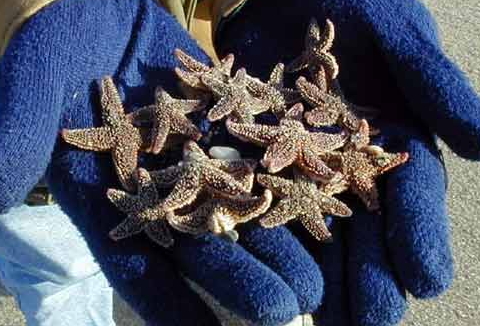
 Sea Stars on Wellfleet’s Atlantic Beach

 Today’s ocean tide brought hopeful signs for the New Year.

 01-04-2 480

For when you wish upon a star, your dreams really do come true — in the Land of Ooze.

New Year’s Wish from the Land of Ooze — 30 December 2000

December 30th, 2000

12-30-1 480

Survival Skills — 27 December 2000

December 27th, 2000

12-27-1 480

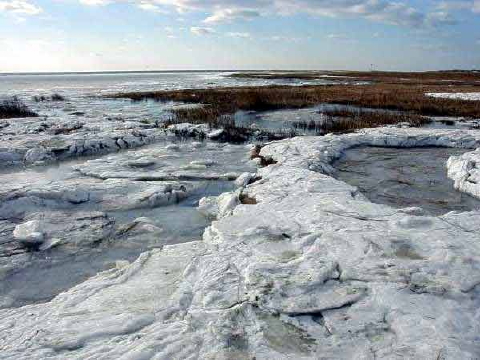
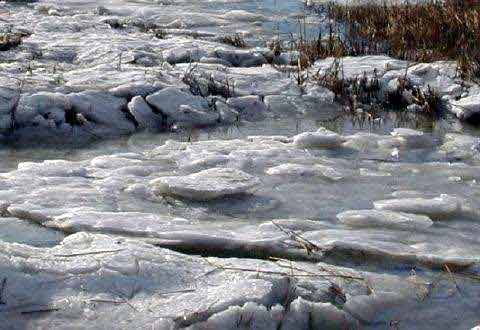
Ice Floes Grip South Wellfleet Marsh

As winter ice locks down the Wellfleet marshes a full month earlier than last year’s freeze, one cannot help but marvel at the amazing survival skills of our local diamondback terrapins who live at the northernmost edge of the species’ habitat.  Unrelenting northwest gales and frigid temperatures have transformed the Land of Ooze into an Arctic landscape.

12-27-2 480

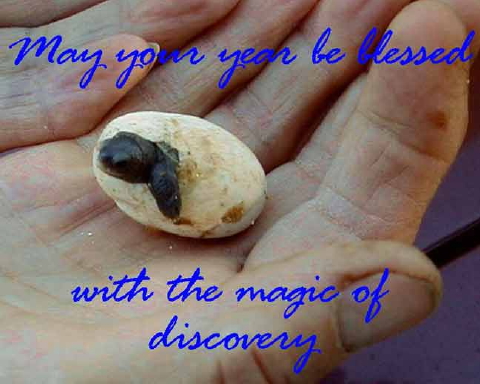
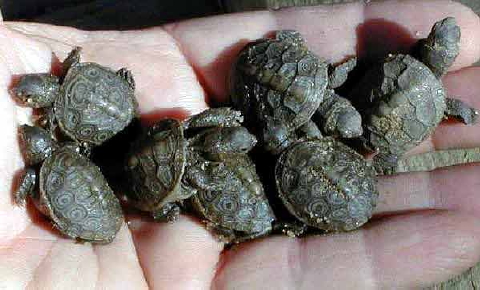
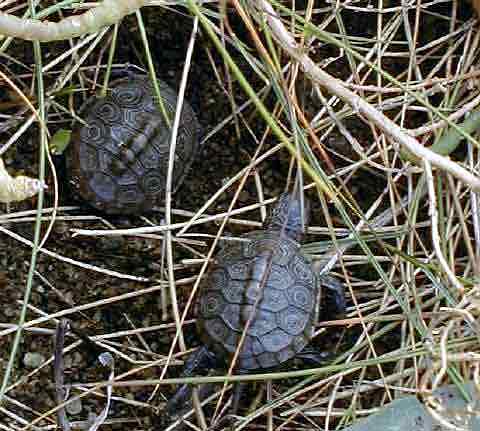
Tiny Terrapin Hatchlings Emerged in Late Fall

Hard to believe . . . just two months ago tiny 6-gram hatchlings were emerging from upland nest sites . . .

12-27-3

. . . and scurrying for the protective nursery habitat of these same salt marsh creeks.

12-27-4

How they manage to endure these harsh winter conditions while their cousins are still basking in Florida sunshine challenges researchers and poets alike.  Three hundred eighty years ago, their ancestors watched stoically as long boats from the Mayflower with our ancestors aboard investigated Wellfleet Bay for the first time.  So, I guess they may be even better at this than we are; they’ve had a lot more practice.  Still, when you look at the very spot where these little critters disappeared into the “safety” of the marsh in October, you’ve got to admire their plucky survival skills.

The Unexpected — 23 December 2000

December 23rd, 2000

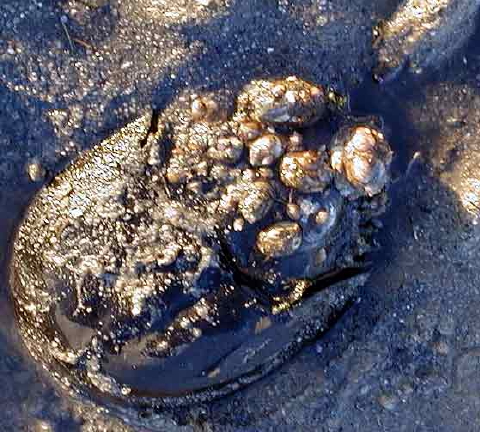
If it’s the unexpected that keeps naturalists energized when conditions would dictate a good book and a raging fire, then I guess I hit jackpot this afternoon.  Temperatures hung in the twenties with sustained 25-knot winds whipping across the bay from the northwest.  The wind chill plunged to zero and below, and several feet of slush ice had formed at the intersection of the channel and the shore.  The last thing I would expect to encounter, other than a stone-cold terrapin of course, would be a live horseshoe crab.  Yet, here was an adult male, sporting a decorative colony of parasite shellfish and burrowed into the low tide exposed beach off Lieutenant Island’s north shore.
12-23-1 480

Live, Exposed Horseshoe Crab in Sub-Freezing Temperature

Last season began an important research program on the Cape to formally study our native horseshoe crab population.  In the face of substantial harvesting of these critters for biomedical purposes, as well as for conch and other fishing bait, we felt obliged to nail down some concrete data to underpin any future policy changes.  As part of this project, nearly a thousand adults were tagged to study migration and behavior and physiology, and to obtain a rough population estimate through capture-mark-recapture efforts over a number of years.

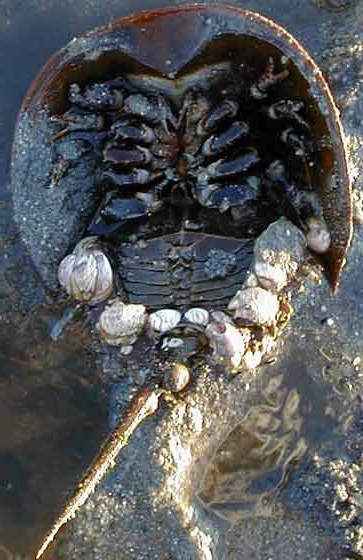
As I patrol wrack-strewn beaches and marshes in the study area, I routinely examine molted shells and horseshoe crab remains, which wash ashore with the tides, to see if they are marked or not.  So, this afternoon at dead low tide as I walked the shoreline and spotted a horseshoe crab shell, I stopped to check it.  I realized at once that this one was quiet alive and had dug itself into the beach sand about two feet from the receding tide line.  I flipped the crab over to determine gender and its reactions were anything but sluggish.  It seemed to move as normally as in the summer.  I saw that he had the telltale “boxing glove” clasper at right front, but the end of the left “boxing glove” appendage was missing.  On his back, the tail immediately went into action to right himself.  I saved him the trouble and returned him to his repose, reburying his shell with moist beach sand.
12-23-2 363

Male Horseshoe Crab with “Boxing Gloves”

What the heck a horseshoe crab was doing out of his hibernacula in these conditions is beyond my ken.  But it’s these little surprises that keeps us outside our winter hibernacula, too.