The Great Escape — 10 April 2001

April 10th, 2001

04-10-1

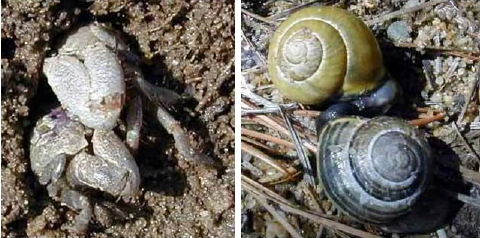
Male Fiddler Crab

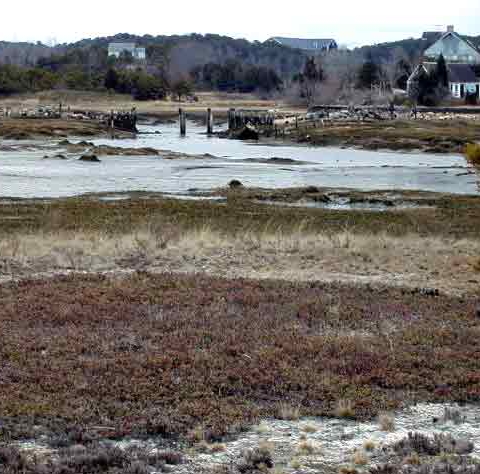
Two days of bright sunshine baked the Land of Ooze, and its mud flats have begun to spring to life.  True, these critters aren’t turtles.  But they do live in the marsh creeks, they burrow under the mud for winter, and they are an imminent precursor of our beloved terrapins.

Water temperatures, even early this morning, had reached 52 degrees Fahrenheit.  Fiddler crabs sprang from the ooze, muddy mounds surrounding escape tunnels.

04-10-2

Male Fiddler Crabs

They haven’t begun to march in armies yet, but they have emerged and that’s a welcomed harbinger of things to come.  Even in the grassy marsh, fiddlers are on the move.

04-10-5 480

Springtime Duets

And it is springtime, so it shouldn’t surprise us that all God’s creatures seem to prefer a two-seater rather than flying solo.

Terrapins Face Winter’s Final Test — 8 April 2001

April 8th, 2001

Full moon intensifies Wellfleet Bay’s already dramatic tidal swings.  Highs rise to nearly plus 13 feet and lows plunge to almost minus 2 feet.  While flood tides threaten coastlines, lows place our sleeping terrapins at greater risk.  Vast expanses of tidal flats and marsh creeks, which are normally protected by bay water, are drained by these astronomical tides, exposing turtles who chose hibernacula a bit too close to the boundary.  While the numbers aren’t great, we recently discovered a pattern of terrapins being dislodged during winter and early spring tidal extremes.  After being summarily unearthed from cozy slumber, these cold-stunned turtles are discovered — if they’re lucky — stumbling along the high tide line where they’ve been washed ashore.  Unless found, most will not survive prevailing air and water temperatures in February, March, and even April.  Today, in this so far bone-chilling springtime, we reached 39 degrees under cold rain and water temperatures over the tidal flats remained in the mid-40s.

04-08-1 480

 Low Tide Drained Loagy Bay off Lieutenant Island

As low tide approached this evening and Lieutenant Island’s marsh drained dry, a resident braved the gloom and bitter weather to discover a cold-stunned terrapin in the high tide wrack.  A 1-year-old turtle hatched in the fall of 1999, this one proved a special find, indeed.  Like most researchers, we rarely see terrapins between the time they disappear into the nursery marsh immediately after hatching and when they pop up again as strapping 3- & 4-year-old juveniles.  The lost years between birth and then are mysteries.  So, we are doubly blessed by today’s discovery.

04-08-2 480

 One-Year-Old Diamondback Terrapin

The turtle measured 4.5 centimeters carapace length (4.0 cm plastron) and weighed in at 16 grams.  The age was confirmed by a single growth line.  Assuming birth in fall 1999 and average hatchling statistics, this little critter looks like it gained a little more than 1.5 centimeters in length and double its 8 gram birth weight in its first season of activity (Year 2000).

Since Flower, the free-loading hatchling box turtle, who moved into my garage in November, has the terrarium booked for the season, I set up a make-shift home for this new boarder.  It’s resting on moist beach sand with a small amount of marsh water at one end, which is heated by a lamp to gradually raise its body temperature.  When first examined, the eyes seemed closed and filmy, but they were still responsive to light.  I witnessed this same pattern in a 3-year-old juvenile (Vito), which was found cold-stunned in the same tidal condition in February 2000 and released last spring.  If the heat works its magic, I expect to see the eyes open in a day or two.

04-08-3-4 480

 One-Year-Old Terrapin with Loads of Scute Anomalies

This young terrapin sports an interesting and anomalous carapace pattern of 19, rather than 13, scutes.

Remains of Seven-Year-Old Male — 7 April 2001

April 7th, 2001

The patrol area this morning was the wrack line around Indian Neck, largely flooded with a nearly 12-foot full moon high tide.  Air temperature lingered in the low forties under partly clear/partly cloudy skies.  Water temperature over the tidal flats of Blackfish Creek remained at 46 degrees Fahrenheit, ten points below the wake-up call for sleeping terrapins hunkered under the mud.  As I passed a colleague’s cottage on Anawan Road, I spotted the remains of a diamondback terrapin, obviously placed there by someone who had discovered it along the marsh and wanted us to find it.

04-07-1

Carcass of Seven-Year-Old Male Diamondback Terrapin

He proved to be a 4.5-inch, mature male about seven years old with slightly flared rear marginals.  He had never been observed before, so was unmarked.  Nor were there any predation scars anywhere on his shell.  From the state of these remains, I presume he died sometime in the fall.  While there is no obvious sign which points to the cause of death, I did note that the last few annual growth rings are very compressed.  Whether this observation indicates some stressful factor in his environment, or merely reflects his natural growth trend as he reached full size at maturity is uncertain.

04-07-4 480

Male Diamondback Terrapin Found Dead in Fox Island WMA

More Nests Discovered and an Old Fatality — 3 April 2001

April 3rd, 2001

04-03-1

Terrapins Nest at Crest of Hill in Walkway of Cottage

Bright sunshine this morning broke a string of gloomy overcast that has gripped the Cape for weeks on end.  The mutts and I exploited this break to scout some new areas where we had seen terrapins heading during last year’s nesting season.  Along the wrack line beyond Lieutenant Island’s Turtle Point and behind Round Island, there rises a bearberry hill, thickly vegetated to a depth of nearly a foot and liberally sprinkled with beach plum and pitch pine.  Turtles negotiate this passage like porpoises in heavy surf, submerging and breaching in waves of cresting ground cover.

04-03-2

Scutes from Large Female Terrapin

Summer never afforded the opportunity to track these turtles to their nesting site.  But with blue skies and time to spare, today offered that chance.  We trudged through the bushes and focused on the only clear area immediately surrounding a seasonal cottage atop the hillside.  As we crossed a predator trail midway to the summit, I spied two dried pleural scute bones from a large mature female that apparently didn’t complete the round-trip nesting run.

04-03-3

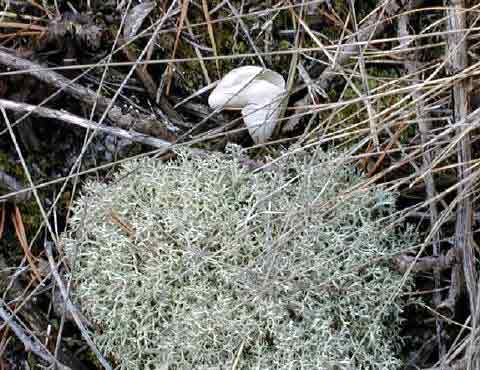
Terrapin Egg Shards

A spot of loose soil at the edge of the cottage’s backyard decking proved too seductive for a nesting terrapin to resist.  With a warm southwest exposure, and human scents aplenty to scare off predators, it was highly successful too.  Several egg shells had been exposed by the rainy deluge we’ve endured this last week.  I excavated two nests to recover a total of 26 hatched eggs: 14 from one and 12 from the other.

04-03-4 480

South Lieutenant Island Marsh and Round Island in Background

I still marvel, though, at the stubborn endurance of tiny one-inch, quarter-ounce hatchlings.  From these nests, they forge a quarter-mile path through walls of vegetation and a backfield of predators to reach the distant safety of their marsh habitat.

Pre–Easter Egg Hunt — 31 March 2001

March 31st, 2001

Nothing is more exciting to a field researcher than discovering a new nesting site.  It signifies a wealth of possibilities for our threatened friends, as they claim yet another beachhead from which to cling to survival.  So, join with me in celebrating a wonderful find on this last day of March.

In the center of Wellfleet lies Duck Creek, once crossed by a long abandoned railroad line stretching out here to the end of the universe.  The creek runs into the Wellfleet basin and pier, which bustle in frenetic activity each summer as urbanites frantically scramble to relax in our rustic hamlet.  The mutts and I braved a set of intimidating “PRIVATE: NO TRESPASSING” signs as we checked the wrack line for any terrapins which may have been dislodged from their winter hibernacula by the last set of new moon tides.  The area is dotted with vacation cottages, now boarded and ghostly in the chilly March overcast.

03-31-1 480

Wellfleet Town Center on Duck Creek

On an easy facing knoll, opposite the old railroad bridge, I spotted a series of scratchings and indentations which could only signify — at least to this terrapin researcher — a nesting site.  On closer examination, the entire hill was pocked with digs.  Now, to an untrained eye these signs may have pointed to a oft-visited dog run.  But, no, I was sure I had found an unknown terrapin nesting site.  The problem, of course, is that with no evidence other than earth disturbances, my assessment would be mere speculation.  And March is a bit late in the year to expect to find remnants of nesting activity.

But the gods smiled.

03-31-2

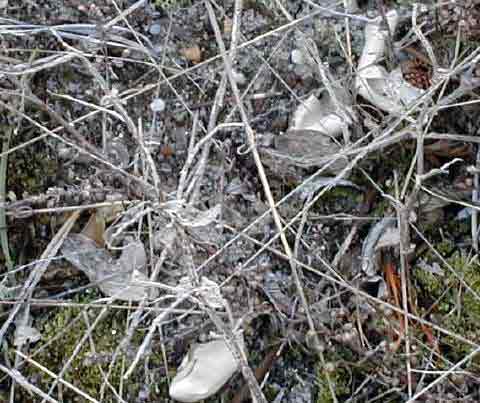
Diamondback Terrapin Egg Shard

Tucked near a tuft of vegetation I spotted the first terrapin egg shell.  Tracing a line back to the nearest dig, I found some more hatched shells.

03-31-3

More Terrapin Egg Shards

And, finally, excavating the nest itself yielded a total of 15 hatched terrapin eggs.

03-31-4

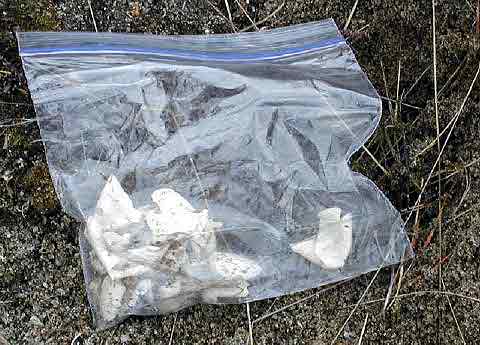
Terrapin Egg Shards Bagged for Analysis

The Duck Creek terrapins have a new nesting site, or at least one we never found before.  And tourists who invade the surrounding cottages each summer will have a bit of natural miracle hatching right under their bedroom windows.