Frozen Diamondback Terrapin Rescued from Near Certain Death in Wellfleet Harbor

February 21st, 2009

imgp1533_0002

Rescued Female Diamondback Terrapin #2102

Tragedy turned into dramatic rescue for a threatened diamondback terrapin yesterday, February 20th, on the Outer Cape.  Applause goes to a very conscientious Wellfleet shellfisherman who made all the right moves to ensure the animal’s survival and to an extremely responsive Wellfleet Bay Wildlife Sanctuary that kicked into action when the call came.  In combination, they saved the life of a mature female terrapin from near certain death in the still frigid conditions of Wellfleet Harbor.  As a bonus, this turtle was an old friend whose rescue added significant scientific detail to our three decade longitudinal study of terrapin populations on Cape Cod.

The call reached Mass Audubon‘s Wellfleet Bay Wildlife Sanctuary around 4 o’clock.  Clint Austin, a Wellfleet shellfisherman, had been harvesting in low-tide drained Chipman’s Cove off Wellfleet Harbor.  Emptied of water, the winter bottom of the cove consists of “black mayonnaise,” an oozy mixture that more than justifies its name, atop a thick, frozen substrate that has been under ice for more than a month.  In the summer, it’s hard to find any bottom under the black ooze that mimics the sucking quicksand scenes from every Saturday matinee Tarzan adventure. 

2102-chipmans-cove-003-fix-840

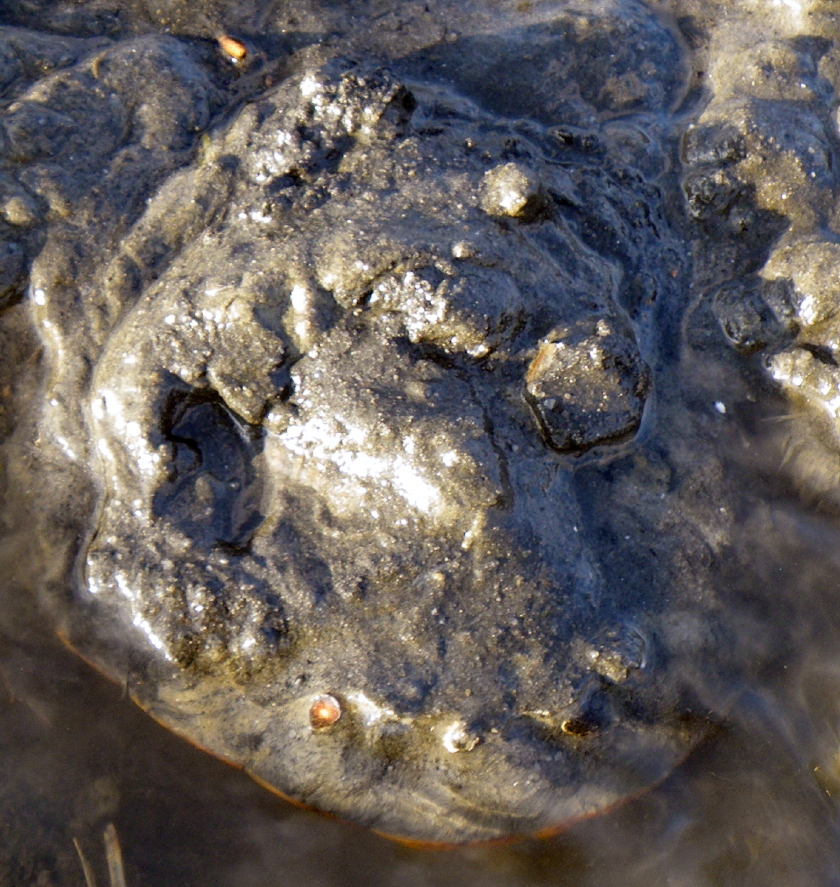
Terrapin Under Thin Layer of “Black Mayonnaise”

Terrapins brumate (the reptilian equivalent of hibernating) in Chipman’s Cove, as well as other estuaries throughout Wellfleet Bay.  As winter lengthens and the ground freezes, they squirm deeper and deeper into the insulating ooze to avoid freezing.  Unfortunately, the 15-foot tidal range between lowest low and highest high tide leaves these estuaries and coves exposed and vulnerable to storms and the scraping of icebergs that drag through the black mayonnaise like ploughs.  And there’s always the unlucky terrapin that chooses just the wrong spot.  So, in February’s thaw as the ice sheet begins to melt, a few terrapins become unearthed from their hibernacula by these forces and succumb to freezing temperatures.


Click Here to View Video in High Quality

Frozen Female Terrapin Rescued from Chipman’s Cove

Fortunately, Wellfleet shellfishermen go out to harvest during these breaks in the ice and many keep a sharp lookout for the harbor’s signature reptile as they gather clams and oysters.  Clint did more than maintain a sharp lookout.  He found the terrapin just beneath the surface in the oozy middle of Chipman’s Cove.  Clint had the foresight to mark the spot with a thin white tube before he called into the Sanctuary with the report of his discovery.  Without that marking, the chance of finding this vulnerable turtle again would have been nil.  To the contrary, following his directions and locating the marker, we discoverd Terrapin #2102 under a fine layer of black mayonnaise with just her bright rear marginals showing.

rescue-of-cold-stunned-terrapin-2102_0001

Ice-Cold Female Terrapin Unearthed from Brumation

How cold was she?  This turtle was so cold to the touch that my fingers nearly froze through my gloves as I carried her back to the car.  We instantly recognized her markings and remembered her from her nesting run on Lieutenant Island’s 5th Avenue this last summer.

Click Here to View Video in High Quality

Cold-Stunned Terrapin Returning to Life in Rehab

Back at Turtle Journal Central, the process of gradually returning Terrapin #2102 to life began.  We slowly raised her body temperature through the night, as we began to clean off layers of frozen ooze.  When she started to act normally, we took weights and measurements to compare with her last observations on June 22nd, 2008.  Clearly, she had enjoyed a very good summer because she had gained 90 grams and added about .25 centimeter to all her linear dimensions in just a few short months.
2102-map-840

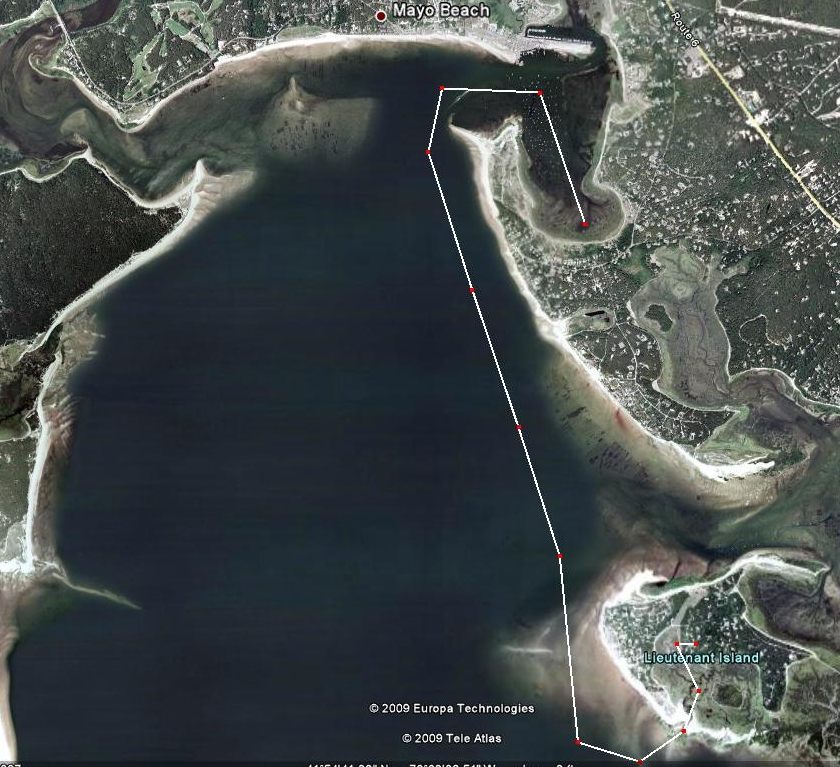
Terrapin #2102 4.5 Mile Trek from Brumation to Nesting Site

Interesting from the standpoint of terrapin movement within Wellfleet Bay was a comparison of her brumation site with her nesting location.  While Terrapin #2102 brumates in Chipman’s Cove to the north in the winter and had been observed previously in the Chipman’s Cove mating aggregation in the spring, she nests on the south side of Lieutenant Island, a trek of 4.5 miles one way.  Observations of terrapins that deposit two clutches annually in Wellfleet Harbor show that they return to their mating aggregation between nests.  For Terrapin #2102 that would involve 18 miles each year for the two 9-mile roundtrips.  Not bad for a non-migratory species!

Cheers to Clint Austin!  Cheers to Wellfleet Bay Wildlife Sanctuary!  And good luck to Terrapin #2102.
Snappy Thrives at Wellfleet Bay Wildlife Santuary

February 19th, 2009

imgp1430_0003

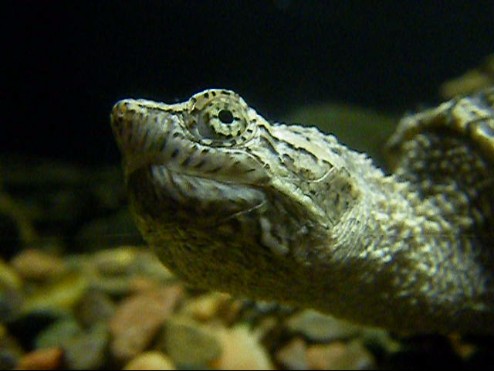
“Snappy” at Mass Audubon’s Wellfleet Bay Wildlife Sanctuary

Yes, sleet and snow fell this morning.  Yes, ice edges the salt marsh channels along the Outer Cape.  Yes, it’s still deep winter outside.  Yet, inside Mass Audubon‘s Wellfleet Bay Wildlife Sanctuary, summer never ends for Snappy, the extremely fortunate snapping turtle hatchling serendipitously chosen to star as the signature critter in the fresh water display tank.  Snappy is simply thriving, growing as fast as the food supply allows.  True, fish can no longer occupy the same tank as Snappy.  Well, not completely accurate; they can occupy the tank with Snappy for a little while, and then they can occupy the less spacious tank inside Snappy’s tummy for a lot longer.

Click Here to View Video in High Quality

“Snappy” Struts His Stuff

No matter the temperature outside nor our temperment inside, a visit to Snappy at the Wellfleet Bay Wildlife Sanctuary brings a warm, summer feeling with bright hopes for the spring season just one month away.  When you see Snappy, tell him the Turtle Journal sent you.  Oh, we recommend that like the fish, you stay out of the tank.

For earlier reports on snappy, see Meet “Snappy” at Mass Audubon’s Wellfleet Bay Wildlife Sanctuary and http://www.turtlejournal.com/?p=1609.


Wareham Courier Reports: “Tiny Turtles on Hand for Talk”

February 18th, 2009

(Click here to read original article posted on Wicked Local.)

 ryan-richardson-001

Wildlife Expert Sue Wieber Nourse Shows Just How Small Two Turtles Can Be (Photo by Ryan Richardson, Wicked Local)

Tiny turtles on hand for talk

By Ryan Richardson

Wed Feb 18, 2009, 06:00 AM EST

WAREHAM – They are hidden everywhere, from the waters of Buzzards Bay to the backyard, a fact many homeowners have found out a little too late while mowing their lawns or backing out of their driveway.

There are almost a dozen species of turtle along the South Coast that visit the waters or make their homes in the areas that are still a little bit wild. From the red-bellied cooter to the loggerhead, the long-living turtles can be found almost everywhere if you know just how to look for them, and few people know where to look better than local turtle experts Don Lewis and Sue Wieber Nourse.

“We’re going to start out with the local guys we run over with our cars…” Lewis interrupted himself. “…That we find in our backyards.”

On Valentine’s Day, the couple came to the Wareham Free Library to talk about turtles.

The first step was to turn everyone in the room into an expert on the reptiles with one word: temperature.

According to Lewis, temperature was the answer to most questions about how turtles function in the world around them.

Whether they’re terrapins, tortoises or sea turtles, as cold-blooded animals, turtles orient much of their lives around keeping their body temperatures in the right range. They spend their mornings basking in the sun on rock sand logs, and they go into a deep hibernation in the winter when the cold slows their bodies down. Temperature can even determine what sex a turtle will turn out to be after it hatches, since unlike humans, turtles don’t have an X or Y chromosome.

For Lewis and Nourse, teaching about turtles is important because many species are threatened or endangered and serve as a signal that their habitats and the rest of the animals that dwell in them might be in trouble. It also doesn’t hurt that children love turtles, teenage mutant ninja or not, and that connection can be used to teach them about the natural world as a whole.

In Massachusetts, the Eastern box turtle is threatened by the destruction of its habitat due to residential expansion. The turtle typically likes to live at the edge of the woods near grassy fields where it’s easy to find slugs and snails, but their habit of wandering into the grass also leaves them vulnerable to one of their main predators: lawn mowers.

Lewis shared a photo of a box turtle with a shell chipped and marred by mower blades when an inattentive homeowner or grounds keeper has accidentally struck one of these slow moving creatures. Although the turtle’s shell can regenerate, it is neither a safe nor pleasant experience for anyone involved.

The red-bellied cooter is listed as endangered by the Massachusetts Department of Fisheries and Wildlife, its range having been confined to a few pools and ponds within Plymouth County. The turtle is easy to distinguish because the bottom shell is either red (for females) or a pale pink (on males).

The cooter spends its life almost exclusively in the water, coming out to lay its eggs in sandy soil or to migrate if the going gets too tough in their pond. The spread of residential areas and the destruction of Pine Barrens has destroyed much of their local habitat, making it much more difficult for the turtles to migrate.

Herbicides and other chemicals used to treat ponds, pools and bogs also slow down the maturation of the cooter and its reproductive cycle. This means fewer and fewer turtles are laying fewer and fewer eggs. There are certain areas in Plymouth where the turtle has been found that are protected, and while the turtle has been spotted in Wareham, their nesting sites haven’t been located.

“We really nee to know where this turtle is in Wareham,” Lewis said.

Lewis also brought along a few diamondback terrapin hatchlings no bigger than a half-dollar. The terrapin is found from the edge of the Cape to New Bedford, but while it is threatened in Massachusetts for many of the same reasons other turtles are, such as the destruction of its habitat by suburban sprawl, there is another reason in particular: Terrapins were very popular in turtle soup through the middle part of the 1900s.

On his way down to his inauguration, John F. Kennedy was said to have stopped at the home of one socialite for a cup of the soup.

“Can you guess why they’re threatened?” Lewis said.

While harvesting the terrapin is now illegal in the commonwealth, the turtle has seen many of the salt-water marshes and estuaries they call home disappear over the years.

Lewis and others are helping the public to see the wildlife around them in the hopes of coexisting a little better, even if it’s just slowing down when turtles are laying their eggs so they don’t run over a few hatchlings during the commute.

Lewis offered one very important reason why turtles were a great animal to study.

“When you get to be a certain age, you like to find a species that you have a chance of catching,” he said.

To find out more about Lewis and Wieber’s investigations into the turtles of the South Coast, visit their Web site at www.turtlejournal.com.

Gatehouse Media New England Interview with Turtle Journal Team

February 17th, 2009

Click Here to View Video in High Quality

Interview with Don Lewis and Sue Wieber Nourse

Ryan Richardson, reporter for the Wareham Courier and representing Gatehouse Media New England, recorded the interview above with the Turtle Journal team, Don Lewis and Sue Wieber Nourse, at the Wareham Free Library on Saturday, February 14th.  The interview is posted on YouTube on the OldCM channel.

“Turtles Gone Wild” S.R.O. Hit at Wareham Free Library

February 16th, 2009

wareham-free-library-valentine-840

Terrapin Poses Traditional February 14th Question

“Never in my wildest dreams did I think that so many people would turn out on Valentine’s Day to hear about turtles,” exclaimed one board member of the Wareham Land Trust that co-sponsored our Turtles Gone Wild presentation at the Wareham Free Library on Saturday.  We were not surprised in the slightest.  When we arrived 90 minutes before the presentation to begin our set-up ritual, librarians and board members tried to lower expectations.  “It’s school vacation week and many families have gone south.”  “Attendance has been so slow for our library programs lately.”  “No one’s coming out on these cold winter days.”  “It’s a holiday weekend and Valentine’s Day.  Who wants to come to the library to hear about turtles?”  And so on.  To each we responded, “You just don’t understand the magic of turtles.  Everyone has a turtle story tucked deep down inside their memories and adults, consciously or subconsciously, want their children and grand children to share these transformational moments.  We will have standing room only.”  And so we did.

wfl-016-prep-840 

“They are just so gorgeous,” he said, only half-joking, as somewhat hideous close-up photos of snapping turtles flashed across the screen.

In the library’s packed meeting room, Lewis, with the help of his partner, Sue Wieber Nourse, inspired adults and children to share his affection for the reptiles with a high-energy, entertaining look at the different types of turtles that inhabit the land and water of SouthCoast and Cape Cod, many of which are threatened or endangered.

The Turtles Gone Wild presentation, attended by at least 130 people, was sponsored by the Wareham Land Trust and the Wareham Free Library.

Children sat on the floor at the front of the room as Lewis told them how to identify different kinds of turtles, and taught them the importance of “temperature, temperature, temperature,” which is the answer to everything from what turtles regulate by basking in the sun to what determines the gender of a turtle.

Lewis never stopped smiling during the presentation, whether he was acting out — very slowly — a box turtle chasing its prey, a snail, or showing video of a diamondback terrapin digging her nest while “The Hokey Pokey” played on speakers.

Many of the photos and videos were of turtles that he found in Wareham.

He even gave helpful tips to people who want to help snapping turtles get out of the road: stay away from their heads, wear heavy gloves or “send the kids out to do it.”

Lewis has rescued and studied hundreds of turtles during his career, and he coupled his enthusiasm for them with advice to people on how to protect them.

He urged people to use caution when mowing their lawns, because box turtles can hide in the grass.

He displayed photos of the rescue of a 950-pound sea turtle that got caught in the lines attached to lobster traps, and described how the turtle glided through the water after it was freed.

“It’s a sight that is absolutely magnificent to see,” he said.

The Wareham Land Trust identifies properties where turtles are found and works to protect them.

For more information, go to http://www.warehamland.org/.

Contact Jennifer Lade at jlade@s-t.com

====================