Archive for the ‘Turtles’ Category

First Loggerhead — 2 December 2000

Saturday, December 2nd, 2000

12-02-1 480

Roiling Cape Cod Bay in December

A stiff north/northwest breeze, mixed with on-and-off snow showers, drove three sea turtles onto Brewster beaches this morning: two Kemp’s ridleys and the first loggerhead of the season.  Today’s rescues brings the total to 28 cold-stunned sea turtles to date: 27 ridleys and one loggerhead.

12-02-2

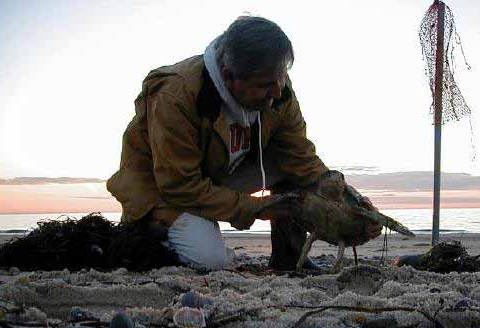
Margot Fitsch with First Cold-Stunned Loggerhead of 2000

Margot Fitsch of Brewster found this first loggerhead near Saints Landing at 8:30 this morning.

12-02-3

Biologist Kathy Tuxbury Hefts 40 Pound Loggerhead

A tad over 50 centimeters carapace length and weighing 41.5 pounds, this small juvenile reminds us how much we miss our resident 3-pound terrapins and dread this back-breaking phase of the sea turtle rescue season.  Yes, they are gorgeous, but a 40-pounder is on the tiny side of the bell curve for loggerheads.  If past is prologue, we’ll be visited by turtles in the 55 to 70 pound range for the next few weeks.  Time to reach for back brace and truss.

12-02-4 480

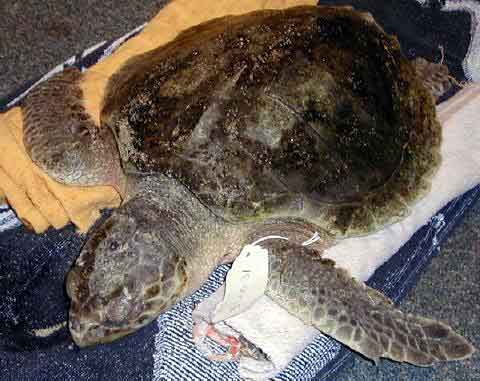
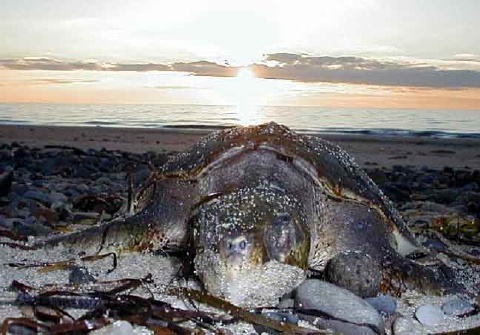
Cold-Stunned, 40-Pound Juvenile Loggerhead Sea Turtle

Even her massive size, compared with the smaller Kemp’s ridleys, didn’t save this loggerhead from severe cold-stunning.  Her internal body temperature registered only 34.9 degrees Fahrenheit.  She and her two ridley companions are en route to the New England Aquarium in Boston for emergency treatment.

Three for Boston — 1 December 2000

Friday, December 1st, 2000

12-01-1

Three Cold-Stunned Kemp’s Ridleys from Brewster and Dennis

This morning’s tide, augmented by a 20-mph northwest wind, delivered three live Kemp’s ridley sea turtles on the shores of Brewster and Dennis: one at Linnell Landing, another at Ellis Breach, and a third at Cold Storage.

12-01-2

Kemp’s Ridley with Internal Temperature of 41.3º F

Internal body temperatures of this batch of turtles registered around 40 degrees Fahrenheit.  The last four ridleys, which came ashore on the 29th at Duck Harbor, have all died.  Examinations showed critically low glucose levels, among other serious medical conditions, and these turtles were assessed in as poor condition as had ever been seen.

12-01-3 480

Cold-Stunned Kemp’s Ridley in Dry Dock

So, to ensure the most aggressive treatment for today’s three, they were immediately dispatched to the New England Aquarium in Boston with the help of the National Marine Fisheries Service.

Miracle at Duck Harbor — 29 November 2000

Wednesday, November 29th, 2000

11-29-1 480

Miracle Kemp’s Ridley Rescued at Duck Harbor

The Cape was cold and blue last week as wave after wave of Kemp’s ridleys washed ashore frozen dead.  Internal body temperatures plunged to 32 degrees, as icy slush began to form along the shoreline.  We knew no ridleys could survive these Arctic conditions, and only a miracle could save any Kemp’s still lingering in the bay.  Well, the weather broke.  We had a few days of moderate temperatures and gentle winds.  And a miracle came to the Duck Harbor beach, bringing four live Kemp’s ridley sea turtles along with it.
11-29-2

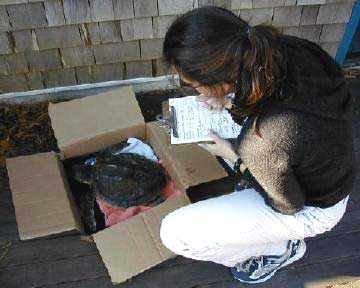
Biologist Kathy Tuxbury Documents Kemp’s Ridley Rescue

Kathy Tuxbury, the research biologist at Wellfleet Bay, discovered the first turtle in the incoming tide at 11:15 this morning.  A nice size juvenile at 30.3 centimeters carapace length and 3.7 kilograms weight, she was quite lively and threatened to nip Kathy as she rescued her from the bay.  Her body temperature registered a surprisingly warm 46 degrees, but her breathing was raspy and fast.  So, we decided on an immediate transport to the New England Aquarium for more aggressive intervention.

11-29-3

Cape Resident Rescues Cold-Stunned Ridley at Duck Harbor

As we prepared the turtle for transport, a resident walking the beach south of Kathy’s find brought in another live ridley from Duck Harbor.  Nearly three centimeters bigger than the earlier turtle and weighing 4.1 kilograms, she too seemed surprisingly well and sported an internal body temperature of 51.6 degrees.  She joined the first turtle in an ambulance run to the Sagamore Bridge rotary for relay to the New England Aquarium in Boston.
11-29-4

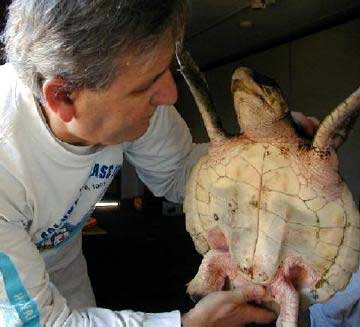
Don Lewis Examines Cold-Stunned Kemp’s Ridley Sea Turtle

By the time I got back from the turtle relay, Kathy had recovered another live Kemp’s ridley from the afternoon high tide just north of the first two turtles.  This one was considerably smaller at 26.65 centimeters and only 2.7 kilograms.  Yet, she too had a 48.5 degree body temperature and seemed in fairly good condition — for this time of year.
11-29-5

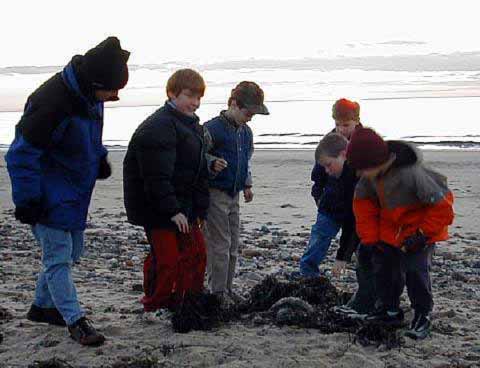
Educator Amy Kiebala Ferreira, Students and Ridley

A phone call alerted us to another ridley immediately in front of the Duck Harbor parking lot.  Amy Kiebala, the Sanctuary’s children education coordinator, raced her team of students to the north Wellfleet beach to rescue this turtle: 31.8 centimeters long and weighing 4.1 kilograms.
11-29-6 480

Don Lewis and Miracle Kemp’s Ridley at Duck Harbor Sunset

We’re counting our blessings tonight: four live Kemp’s ridleys, the rarest sea turtle in the world, at least a week beyond any reasonable hope of finding another one alive in Cape Cod Bay.  We’re doing a lot of quick thinking, too.  How could these critters have survived last week’s frigid conditions.  Was there a warm sink somewhere off Wellfleet in which these turtles were able to hunker down and avoid freezing?  Or did these ridleys mysteriously snap back from the ~ 32 degree internal body temperatures we recorded around 23/24/25 November?  Whatever the reason, we’re not looking a gift horse in the mouth.  But we are still looking.  Tomorrow morning sea turtle patrols will hit Wellfleet and Truro beaches around Duck Harbor, praying for a few more miracles.

Dark Night — 25 November 2000

Saturday, November 25th, 2000

While strong winds and high tides drive cold-stunned sea turtles onto November beaches, perting our attention to these visitors, exotic and tropical, we can’t forget Cape Cod Bay’s resident turtles — the exquisite, yet threatened, diamondback terrapins.  And while most right-thinking terrapins have burrowed under the ooze for seven months of well-earned brumation, their habitat warrants constant inspection to ensure it remains hazard free and to collect the remains of turtles that may have succumbed to some unfortunate circumstance this fall.  Luckily, the sea turtle patrols demand high tides and the salt marsh sweeps need low tides.

11-25-1

Full Moon on November 25th

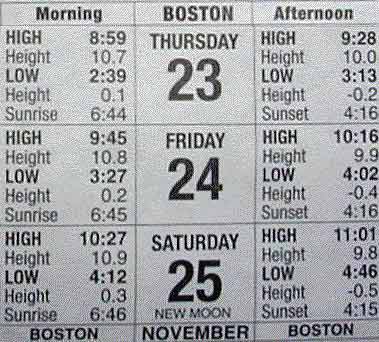
One disadvantage of a new moon cycle in late November at the northern end of the universe is trying to find a usable conjunction of low tide and sunlight.  Today, for instance, the morning low comes two and a half hours before sunrise, and the evening low falls a half hour after sunset.  I chose evening.  On the plus side, though, this latest string of frigid days has coated the muddy muck with a thin layer of ice, allowing deeper penetration into the marsh.  That is, as long as you engage in something akin to a “chicken walk,” placing each boot gingerly, yet squarely on the ground ahead, spreading your weight as evenly as possible, and quickly moving on before you break through the wafer crunch and sink into quick mud.  Perhaps we should trade-in our boots for chicken feet or snow shoes.

Peering through the murky darkness, I spotted a dead female terrapin lying plastron-up at the edge of the main marsh creek south of Indian Neck’s Fox Island.  A quick flashlight check of her marginals showed she had been captured and marked previously: #388.  Her history would have to wait until I could search the database back home.

11-25-2 480

Dead Female Terrapin 388 in Fox Island WMA

Terrapin 388 had first been observed on 12 July 1995 as she came ashore on Lieutenant Island (across the channel from the Indian Neck marsh where she now lay dead) to nest on a dirt road by Turtle Pass.  At the time she was 16.0 centimeters carapace length and 680 grams weight, both of which indicate that this July afternoon a half decade ago marked her first year of sexual maturity and her first nesting season.  Since then, she had increased about a centimeter in all dimensions, a normal growth pattern for mature Wellfleet terrapins.  And she died at the height of her productive years.

11-25-5 480

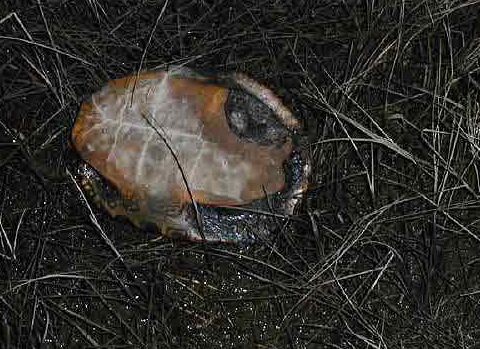
Carapace and Plastron of Dead Terrapin 388

Her body was mostly decomposed, yet her shell showed no signs of predation or injury.  The only marks she sported were some mating scratches on her 5th (rear) vertebral.  Unfortunately, her remains bring us no closer to definitively establishing the cause of death for the 23 terrapin carcasses we recovered so far this fall from the Fox Island Wildlife Management area.

Deep Freeze — 24 November 2000

Friday, November 24th, 2000

11-24a-1 480

Three Frozen Kemp’s Ridley Sea Turtles

The Sanctuary’s recovery room transformed into a morgue as frigid conditions grip Cape Cod Bay.  Three frozen Kemp’s ridley sea turtles lay in a row.  Two had washed ashore on Truro’s bayside beaches; the third was discovered in Orleans’ Rock Harbor.  All dead on arrival.

11-24a-2

Kemp’s Ridley with 32.7 Degree Internal Body Temperature

A fourth ridley was found by beach walkers as she came in with the tide at Linnell Landing in Brewster this morning.  With an internal body temperature of 32.7 degrees, there was little hope.  While her skin still seemed fresh to the touch, there was no observable reaction to stimuli, and her lungs seemed filled with water.

11-24a-3 480

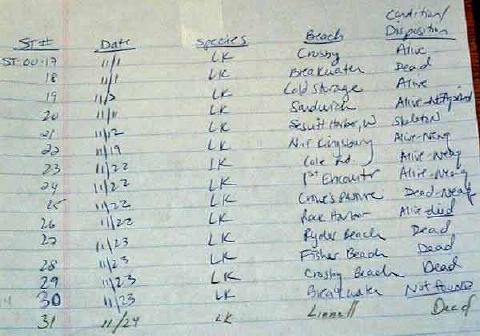
Fifteen Cold-Stunned Kemp’s Ridley Sea Turtles

Our informal running tally shows 15 “LK” (Kemp’s ridleys) sea turtles recovered since 1 November, one of which (ST-00-21) may have been a leftover from last year’s strandings.  And with air temperature dropping into the low 20s, wind chill in the single digits, and water temperature recorded yesterday at 2.5 Celsius, there remains little but hope and prayer for a miracle to save any ridleys still lingering in the bay.

Conditions are ripe, though, for the first loggerheads — with their greater body mass and tank-like resilience — to make an appearance.