Archive for the ‘Turtles’ Category

Pregnant Pause — 8 June 2001

Friday, June 8th, 2001

06-08-1 480

Gravid Female Terrapins in Blackfish Creek Rip

Mid-Atlantic colleagues reported terrapins nesting as early as the third week of May.  Our neighbors in Rhode Island began welcoming nesters this last weekend.  So, we have balloons ready and champagne chilled — waiting for Wellfleet turtles to scramble upland and plant the first eggs of the season.  This morning marked an important milestone on the road to nesting.  Two mature females, which were captured flowing through the rip in Blackfish Creek, were clearly gravid with eggs palpable.

Terrapin 1044 (20.5 centimeters and 1400 grams) and Turtle 1048 (18 centimeters and 1115 grams) both tested positive.  The other mature female seen this morning, #1099 (17.7 centimeters and 975 grams) showed no obvious sign of gravidity.  The rest of today’s captures included two pre-pubescent females and two mature males.  Of these seven turtles, three were recaptures and four were first timers.

06-08-2 480

Doreen Leggett Reports on Lieutenant Island Terrapins

Helping to spread the word across the Land of Ooze about our threatened diamondback terrapins and to increase awareness as nesting season approaches, the Cape Codder newspaper published an excellent article on how Lieutenant Islanders and all Wellfleetians make sacrifices to ensure the survival of terrapins on the Outer Cape.  Ms. Doreen Leggett, who staffs the environment beat, wrote a compelling two page story that even included a comprehensive fact sheet on terrapins out here at the northern edge of their universe.  Hats off to Doreen and the Cape Codder.

Black Jack! — 7 June 2001

Thursday, June 7th, 2001

06-07-1

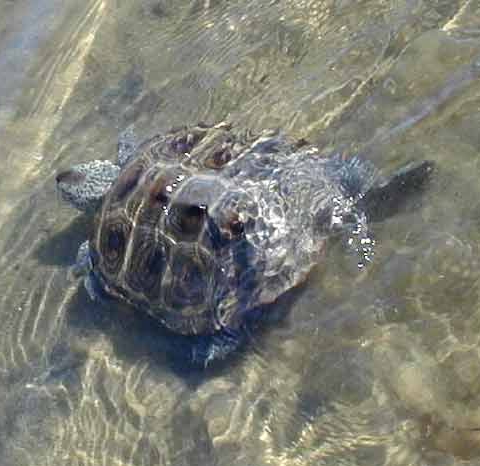
Terrapins Swimming through Blackfish Creek Rip 

It’s hard to even describe a day with so much activity and diversity.  In the end, though, we hit Blackjack! — 21, that is.

This morning conditions improved in Blackfish Creek.  Winds subsided and water cleared.  So, terrapins passing through the tide drained rapids became quite visible.  We netted a baker’s dozen.  Nine females, four males.  Four were recaptures; nine were observed for the first time.  Lots of juveniles with nine turtles 6 years old or younger.

06-07-2

Research Assistant Maureen Examines Captured Terrapin

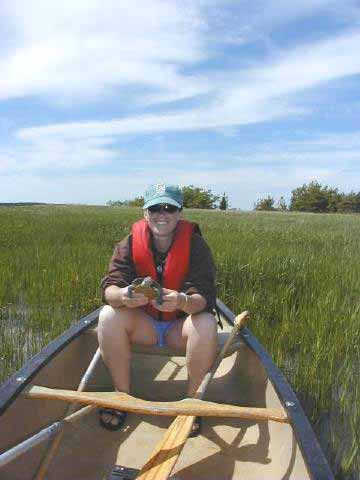
After an orientation session on Great Island, action moved to a very different venue from the marsh creeks.  We loaded a canoe and drove to high tide flooded Chipman’s Cove, a large protected basin abutting Wellfleet’s town pier and harbor.  Here the technique involves a daring gymnast standing at the bow of the canoe with a dip net on a ten foot pole, spotting turtles hiding among thickets of dense vegetation amid gushy mud flats.  The other member of the pair powers the boat in zigs and zags to mirror the escape route of fleeing terrapins.  One false step and canoe and canoeists disappear into the soft underbelly of the Land of Ooze.

06-07-3

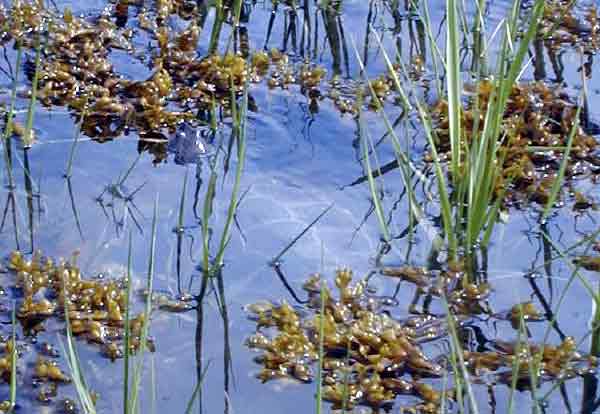
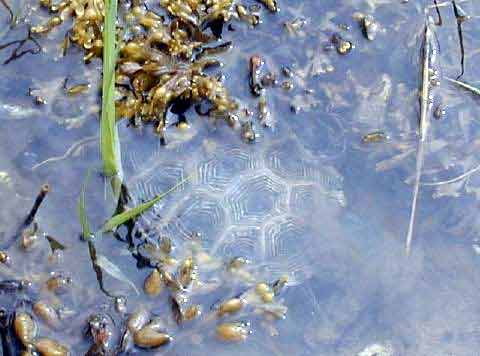
Female Terrapin Hiding in Seaweed and Marsh Grass

Well, not only did all survive, but we managed to net another eight turtles.  Seven females and one male.  One recapture and seven first timers.  Only two were juveniles and all the rest adults — excluding the canoeists, of course.

06-07-4

Female Terrapin #726 in Chipman’s Cove 

The one recapture was particularly rewarding.  First seen three years ago on 12 June 1998, Terrapin 726 was a 5-year-old who measured 12.4 centimeters and weighed 310 grams.  Researchers at the time identified #726 as male.  Even though these measurements fell within the parameters of a male, my experimental model for distinguishing gender for individuals, which do not yet show secondary sex characteristics, spotlighted this identification as incorrect.  The model predicted female. I noted this prediction in an amended database entry.  Today Terrapin 726 was netted again: a beautiful, sexually mature, 17-centimeter, 800-gram FEMALE.  SHE is pictured above shortly after release. 

06-07-5

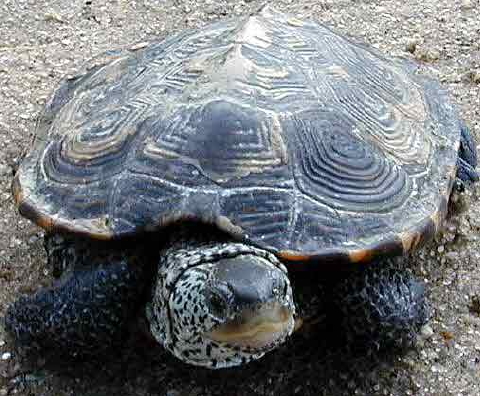
Diamondback Terrapins Released after Processing

All things considered, a very good day at the end of the terrapin universe.

An Unusual Day — 6 June 2001

Wednesday, June 6th, 2001

With northwest wind howling across the bay, and salty foam frothing the creek like bubble bath, this morning’s low tide seemed slightly off tempo and definitely in a minor key.  Even the turtles smirked a knowing glance that all was not quite well in the Land of Ooze.

06-06-1 480

Adult Male Terrapin #701

Despite rough visibility, five terrapins were captured: one adult male (#701 above) and four pre-pubescent females.  Each in its way presented head-scratching anomalies.  Terrapin 701 was last seen exactly one year ago in the same spot, Blackfish Creek.  Since then he managed to ding his carapace midway along the left side marginals.  He also showed an injury to his right rear limb which left a small scar and two missing claws.

06-06-2 480

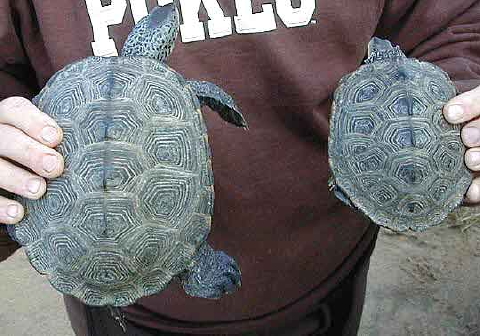
Normal 8-Year-Old Female Terrapin (left), Small 8-Year-Old Female Terrapin (right)

Then there was Turtle #1077.  She’s a very small 8-year-old female with 17, vice 13, scutes on her carapace.  Several of her annual growth lines are tightly compressed, and at less than 11 centimeters carapace length and only 254 grams, she’s far below the growth model for an 8-year-old female — much closer to the expected size of a male at that age.  Yet, all identifying sex characteristics mark her as female.  For comparison, see Terrapin 1078 (another and a typical 8-year-old female) and Terrapin 1077 below.

06-06-3 480

Traumatic Injury to Female Terrapin #1078

Turtle 1078 doesn’t escape the weirdness of this day.  In fact, she may be the most unusual of all.  In every respect, #1078 seemed a well nourished and normal pre-pubescent female in her last season before full sexual maturity — that is, nesting.  She measured 15.2 centimeters and weighed 567 grams.  The nesting threshold for Wellfleet Bay hovers around 15.75 centimeters and 650 grams.  But when she was examined closely, Terrapin 1078 showed serious recent trauma to her rear limbs.  It looked as though she had been caught in something and, in the struggle to break free, had injured herself.  With a deep gash and necrotic tissue showing on her right rear limb, we opted to rush her to the Humane Society’s Cape Wildlife Center in West Barnstable under veterinary director Dr. Rachel Blackmer.  The consensus assessment was that the right limb would need to be amputated above the injury, but that the left would heal.  Under Dr. Blackmer’s medical care, there is every expectation that she will return to the wild in a little over three weeks, and with any luck, be nesting by this time next year.

06-06-4

Cape Cod Photo-Journalist Merrily Lunsford

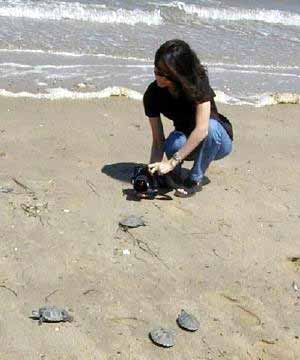
The other two captures were frisky juvenile females, 5 and 6 years old. Like all youngsters these critters were spunky and entertained the staff photographer, Merrily Lunsford, from the Cape Codder newspaper who tried to document their chaotic scramble back into the bay.

Hobson’s Choice — 4 June 2001

Monday, June 4th, 2001

South Lieutenant Island presents diamondback terrapins with a Hobson’s choice: marginal nesting sites surrounded by the best developmental habitat in Wellfleet Bay.  Except for a single isolated sandy face where predation rates soar to over 90%, the south side of the island is ringed by a narrow strip, sometimes only inches wide, of soil and mixed vegetation between the high tide wrack line and a dense bearberry groundcover.  Turtles can opt for the more appealing dirt roads and driveways, but at the risk of encountering a host of predators, wild and mechanical, en route upland.  And the trek back to the nursery marsh for hatchlings would be doubly dangerous.

06-04-1 480

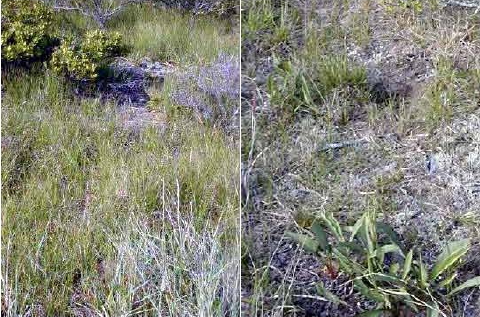
 Marginal Terrapin Nesting Site North of Round Island

Two nests, indicated by red turtles on the orthographic map above, illustrate this dilemma.  Only 50 feet apart, these turtles choose equally borderline nesting locations.  The one on the left found a small scratch of soil (top center of photo) beneath a beach plum bush; the one of the right picked a location (dark spot 2/3s up & center right) sprinkled with grass and weeds.

06-04-2-3 480

Marginal Terrapin Nesting Site North of Round Island 

Although riddled with roots, the left nest still yielded 14 live and emerged hatchlings.  The other, though, was invaded by vegetation which penetrated the eggs and killed the pipped hatchlings.  The only difference I could detect was that the soil in the first, productive nest felt moist to the touch; the second was bone dry — even after a soaking rain and fog.

06-04-4

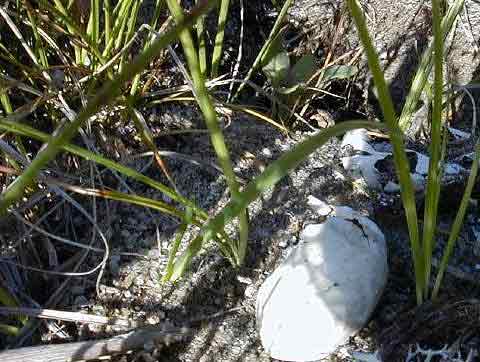
Egg Shards Near Marginal Terrapin Nests

Despite these hurdles, the overwhelming advantage of its abutting pristine marsh has made Lieutenant Island the most productive terrapin hatchery in Wellfleet Bay.

Hints of a New Breeding Population of Diamondback Terrapins — 3 June 2001

Sunday, June 3rd, 2001

06-03-1

 Fog Enshrouded Pilgrims Monument in Provincetown

Fog rolled in thick enough to ooze puddles along Cape roadways and to shroud Provincetown’s Pilgrim Monument in London-esque mystery.  A perfect day for a detective story, especially one with a surprise happy ending.  Into this dense veil walked an alert couple just after noon.

06-03-2 480

Couple Discover Tiny Terrapin Hatchling at Crosby Beach

They chose Crosby Beach in Brewster and strolled its rolling sands toward the mouth of Namskaket Creek.   On the beach (at the spot marked with the red turtle), they detected a most unusual sight: an inch-long crawling pebble.

06-03-3 480

Six Gram Diamondback Terrapin Hatchling

Knowing they found something extraordinary, they called the Wellfleet Bay Wildlife Sanctuary for an identification.  To confirm its ID, the couple was asked to bring the specimen to the Nature Center for an expert examination.  Sure enough, they had discovered a 2.68 centimeter long, 6 gram diamondback terrapin hatchling.

While we suspected from the quality of the marsh and the surrounding uplands that terrapins may be present in Namskaket Creek, we have never been able to confirm that suspicion.  On 30 March 2000, the remains of a 9-year-old female was discovered on nearby Linnell Landing, sparking our interest again in Namskaket.  But it could have washed up from anywhere along the bayside coast in a spring storm.  We needed a live sighting to confirm our surmise.

Today, Hatchling 011-01 provides that evidence.  We’ve alerted the Cape Cod Nature Network of this find and asked folks to be alert to nesting females on surrounding uplands (dunes, wrack lines, dirt roads and driveways), beginning next week and until around 20 July.  We’ll launch a sweep of these same uplands during and after the nesting season in search of terrapin signs.

Namskaket lies midway between the large population in Barnstable Harbor and the northernmost population in Wellfleet Bay.  A new breeding population in Namskaket Creek would be an important discovery for Cape Cod’s diamondback terrapins.