Who said that turtles are slow? Try to keep up with this diamondback terrapin racing through salt marsh and seaweed along the Chipman’s Cove shoreline.
Terrapin Demonstrates Speed & Agility in Chipman’s Cove
Who said that turtles are slow? Try to keep up with this diamondback terrapin racing through salt marsh and seaweed along the Chipman’s Cove shoreline.
Terrapin Demonstrates Speed & Agility in Chipman’s Cove
It’s late April and a few terrapins from the northernmost population are beginning to stir in Chipman’s Cove. These two females were captured for post-brumation data sampling and are being released back into Wellfleet Bay.
First Captured Terrapins Return to Chipman’s Cove in Late April
The Caneel Bay Resort in St. John offers access to exquisite reef ecosystems that have been largely protected over time. Off Caneel Bay’s Scott Beach you find a beautiful, clear patch of turtle grass, and unsurprisingly you may expect to encounter geen sea turtles grazing along the shallow bottom.
Green Sea Turtle Grazing off Caneel Bay, St. John, USVI
Sea turtles are internationally and federally protected species; give them a wide berth and take no action that might disturb their natural behavior. But pause to enjoy their majestic presence as they swim gracefully by and surface for air between belly-fuls of turtle grass.
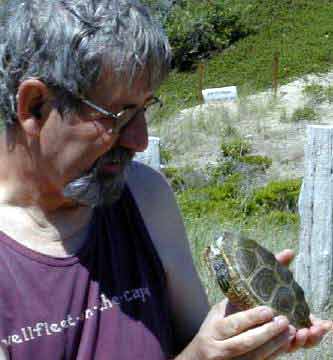
Soaked Turtle Researcher Don Lewis and TerrapinÂ
If your correspondent looks a bit disheveled and waterlogged, chalk it up to a Steve Irwin (a.k.a. Crocodile Hunter) moment. What’s that? An instant when rational thought yields to exuberance . . . when doing trumps thinking . . . when turtler gets turtled.
The tide was not good for terrapin research. Between too high water and a westerly breeze blowing the long fetch up Blackfish Creek, we didn’t stand a chance. So, as we paddled kayaks back across the channel, emptied handed and dejected, I was surprised to see a female terrapin coming straight at my boat, about two feet off port, heading in the opposite direction at the speed of the current, augmented by her powerful kick strokes, and escalated by the closing rate of my kayak.Â
That’s when insanity struck. Without a net, my only chance was to actually catch the speeding bullet by hand. No time to assess risk, I reached for the terrapin, held her in one hand, as the kayak “turtled†on top of me. The plosh could be heard the length of Blackfish Creek. I was upside down, under water, staring an equally surprised terrapin eye-to-eye. Somehow I managed to wiggle out of the kayak, stand waist deep in creek and mud, lugging the water filled boat with one hand and gently cradling the turtle in the other, as I waded back to shore. Amid calls for a reprise from a hastily assembled audience of weekend invaders who had missed the photo-op of a lifetime, I bowed deferentially and settled down to transition from (mis)adventure to science.
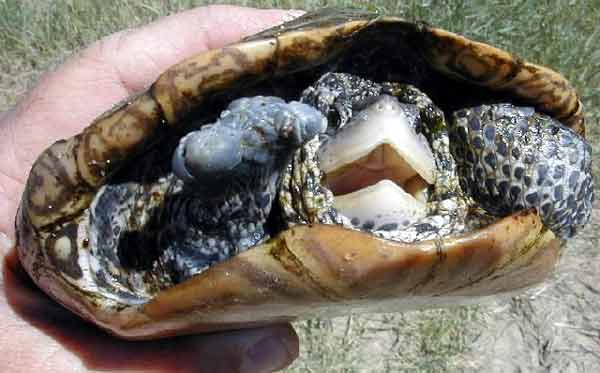
Female Terrapin #1105 with Healed Limb TraumaÂ
Number 1105 was a first time capture. She is a 9-year-old terrapin at 16.65 centimeters and 786 grams, who shows signs of a misadventure of her own. Her right front limb is missing below the joint in a wound which has well healed over time. She also had lots of mud in her frontal cavity and even more in her rear quarter. Other than the limb, she seemed a healthy and normal post-pubescent female.Â
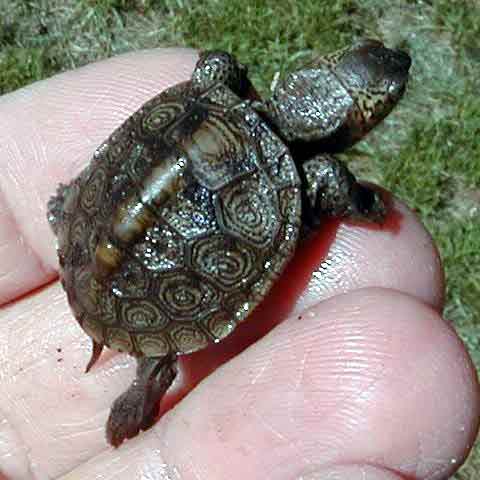
Tiny Three-Gram Over-Wintered Terrapin HatchlingÂ
In the early afternoon, a resident of Lieutenant Island discovered a tiny hatchling in his driveway. Obviously over-wintered, this baby is the second smallest in our records at 2.42 centimeters carapace length and only 3 grams. Undeterred by its miniature status, it proved energetic and ready to conquer the world. These little critters are so comically feisty in their approach to life that you gotta love ’em.Â

Nesting Female Diamondback Terrapin #1106
And this evening brought the first observed nesting terrapin in Wellfleet Harbor for the 2001 season. At 4:30 P.M., a researcher found tracks that led from the high tide water edge on Lieutenant Island’s north beach up to and over the dune known as Turtle Pass. A search of the island by the Paludal Posse discovered a female terrapin crawling down slope along a dirt road leading from the island’s northwest high point. She was dust covered and had already deposited her eggs somewhere upland of the spot she was found. Terrapin 1106 is approximately 14 years old, 17.2 centimeters long, and weighs 824 grams. With her appearance as a benchmark, we can anticipate nesting to escalate until it crescendos during the last week of June, then taper off just as gradually until ending in late July. As witnessed by the multiple tracks she crossed en route from her nesting site, she and her sisters take on quite a risk when they come ashore.

Diamondback Terrapins in Wellfleet’s Blackfish Creek
Some days swirl while others laze. Today fell on the swirl size of the continuum. Morning began with turtles shooting the rapids of Blackfish Creek as a 2-knot current drained their marsh habitat. Two old friends passed through the rip. Terrapin 33 was first observed as 7-year-old pre-pubescent female in 1989, measuring a mere 15.1 centimeters and weighing only 371 grams. Today she’s a mature turtle and one of the larger females in Wellfleet at 20.4 centimeters and 1500 grams. Turtle #283 was first marked as a mature 12-year-old nesting female in 1992. Since then she’s added another centimeter of growth and 100 grams of weight. Neither exhibited palpable signs of gravidity. They were joined this morning by 1103, a mature male of undetermined age, and 1104, a 6-year-old immature female. Coincidentally, these last two measured precisely the same length 11.66 centimeters. The male weighed 260 grams and the female 300.
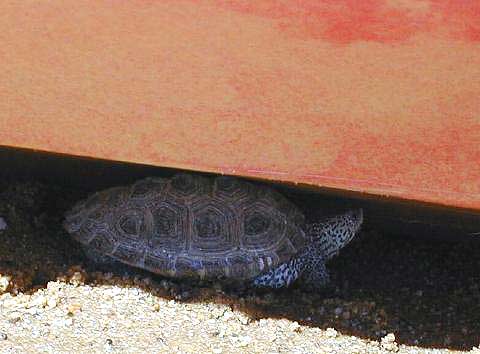
Young Female Terrapin #1104 Hides Under KayakÂ
Not everyone seemed in a hurry to get moving. The young female (1104) decided to hide under the kayak when released, rather than scrambling to the water with her comrades. This behavior, hiding under the boat or some nearby object, seems more prevalent in juvenile terrapins.
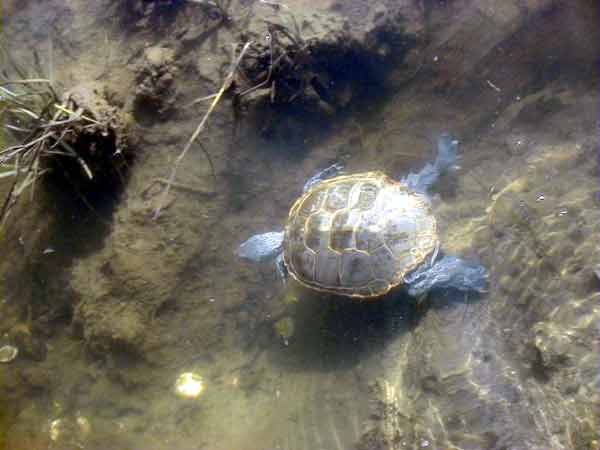
Diamondback Terrapin #223 in Lieutenant Island Marsh
With this evening’s high tide, we began nesting checks to look for that first nester of the season. As we rounded Turtle Point on south Lieutenant Island, I spotted a female head in a flooded tidal pool and creek channel about 500 feet into the marsh. I circled around to approach the area from bayside to get between her and open water. As I approached the channel, a previously unobserved male surfaced, took one look at me (and my trusty net), and decided the better part of valor called for flight rather than fight. He gulped air, kicked, and scooted for the bay, leaving his sweetheart to fend for herself.
Terrapin 223 was deeper into the creek and decided to evade capture by hiding in its murky marsh thickets. It nearly worked since the creek was bracketed by oozy mud banks and its bottom consisted of quick mud. But hey — if you’re not getting dirty, you’re not having fun. I did and I did. Number 223 is an old friend of the research program, first captured as a juvenile in the summer of 1990. She was last seen on a nesting run in this same creek channel on 18 June last year.

Terrapin Volunteer Liz Moon Processing Turtles
We’re still waiting for the season’s first nester. A volunteer called this evening to report what may have been scratchings of a false nest on Indian Neck. With high tides on Monday, Tuesday, and Wednesday coinciding with dawn, it would be a sound bet that the nesting season is about to kick off — with gusto. Volunteer extraordinaire Liz Moon arrived from the mainland in time to join this morning’s roundup. Working on her second decade of terrapin research with Mass Audubon. Liz returns each spring to document nesting turtles in Wellfleet Bay.